Saturday, December 7, 2019

The Beatitudes: Those Who Mourn

“Blessed are those who mourn, for they shall be comforted.” (Matthew 5:4)

Why do the disciples of Jesus mourn? They mourn for their sins, the sins of others, for evils, for unjust suffering they endure, for the suffering that others experience. Jesus mourned during His time on earth when He saw sin and death in His world. The blessed ones are not those who are above suffering and sadness, detached from this world. No, they are those who in this age mourn. They know the glory that was lost and miss it. They are appalled at the corruption in this world and in their hearts. And so they are sad.

Why are they blessed? Mourning is not inherently a blessing, but the promised comfort is. It is those who now mourn that shall be comforted. They shall receive the glory that was lost. God will wipe away their tears and take away their pain and sorrow. They shall know everlasting joy in union with God. Even now they know the comfort of God's promises and His ongoing care. Even now they receive His comfort through His word and His people (see 2 Cor. 1:3-7). But those who do not mourn over their sins, who are gay and jolly now despite their sins and the evil of this world, they shall not find comfort in the time to come.

Do you mourn? Have you been touched with sadness for your sins? Do they bring you sorrow? Does the corruption of this world bring you sorrow? Can you say with the Psalmist: “My eyes shed streams of tears, because people do not keep your law” (Psalm 119:136). Do you mourn over the sad condition of Christ’s church, its impurity, its disunity, its sins and errors, and the suffering it receives from its enemies? If you do not mourn, it is not for lack of things to mourn for.

As disciples of Jesus, be those who mourn. Do not mourn without hope, and do not mourn greatly over the little things and little over the great things. Do you desire to be a better mourner? Then reflect on what is good and love it. Then turn your gaze to this present life and see where it falls short - the sin, the curse, the suffering, the disgrace. Do not harden your hearts.

If you mourn in this way, then take heart - you are blessed. You shall be comforted. You shall know enduring, everlasting comfort. Even now, you shall begin to be comforted by God’s word and promise, by His presence and favor. Even now, you shall gain a foretaste of this comfort, and even the foretaste is more meaningful and substantial than the weak comfort of the apathetic and self-satisfied.

--------------------------------------------------

For prior posts in this series, see:
1. "The Beatitudes: Introduction"
2. "The Beatitudes: The Poor in Spirit"

Wednesday, December 4, 2019

The Beatitudes: The Poor in Spirit

“Blessed are the poor in spirit, for theirs is the kingdom of heaven.” (Matthew 5:3)

"Return of the Prodigal Son" by Rembrandt
Who are the poor in spirit? The poor are lowly, afflicted, and in need. The poor in spirit are this way, but not externally in wealth or class, but in spirit. The poor in spirit are inwardly afflicted over their sins, they are humble before God and man, and they beg for God’s mercy, knowing their need. Those who follow Christ see themselves as poor in spirit, dependent upon God’s grace. They have an attitude of humility and gratitude.

Why are the poor in spirit blessed? Because this is how one receives the kingdom of heaven, with repentant humility and grateful trust. As Jesus said in Luke 18:17, "Truly, I say to you, whoever does not receive the kingdom of God like a child shall not enter it." The kingdom of heaven does not belong to the self-satisfied, the self-confident, or the proud. It belongs to the childlike, the penitent, the grateful. The kingdom of heaven belongs to beggars of mercy. Though they may look afflicted and lowly, yet they are blessed citizens of the heavenly realm.

So consider: are you poor in spirit? Do you realize your poverty? Do you prize Jesus like a poor man prizes his daily bread? Do you realize why He is so needful?

Set aside your self-sufficiency and be poor in spirit. Continue to subdue your pride and cultivate a penitent spirit. As Martin Luther said in the first of his ninety-five theses, "When our Lord and Master Jesus Christ said, 'Repent' (Mt 4:17), he willed the entire life of believers to be one of repentance." On his deathbed, the final words of Luther also reflected this beatitude: “We are beggars. It is true.” May that be your attitude toward Jesus - come to His word as beggars, come to His Supper as beggars, come to prayer as beggars. He exalts the lowly and will not turn away the one who comes to Him broken and needy.

If you are poor in spirit, take heart - you are blessed! Yours is the kingdom of heaven! Blessed are you who have been struck with the holiness of God and have humbled yourself before Him! Blessed are you who realize your need and turn to Christ and the riches of His grace! You have entered the heavenly kingdom, the realm of God’s blessings.

---------------------------

For the first post in this series, see: "The Beatitudes: Introduction"

Tuesday, December 3, 2019

The Beatitudes: Introduction

Over the next several weeks, I will be posting a series on the Beatitudes as they are recorded in the Gospel according to Matthew (5:1-12). Here I want to make some general observations about the Beatitudes. They read as follows:

"Seeing the crowds, he went up on the mountain, and when he sat down, his disciples came to him. And he opened his mouth and taught them, saying:
'Blessed are the poor in spirit, for theirs is the kingdom of heaven.
Blessed are those who mourn, for they shall be comforted.
Blessed are the meek, for they shall inherit the earth.
Blessed are those who hunger and thirst for righteousness, for they shall be satisfied.
Blessed are the merciful, for they shall receive mercy.
Blessed are the pure in heart, for they shall see God.
Blessed are the peacemakers, for they shall be called sons of God.
Blessed are those who are persecuted for righteousness' sake, for theirs is the kingdom of heaven. Blessed are you when others revile you and persecute you and utter all kinds of evil against you falsely on my account. Rejoice and be glad, for your reward is great in heaven, for so they persecuted the prophets who were before you.'"
1. The Beatitudes are descriptions of Jesus' disciples. It is the disciples of Jesus who are the primary audience of this teaching: "his disciples came to him." He had begun calling His disciples in chapter 4, telling them to follow Him, and now they begin to learn what it means to follow Jesus. He is not giving principles of generic morality which you can plug in to any religion. He is talking about those who follow Jesus (4:19), who suffer for His name’s sake (5:11), who will be judged by Jesus on the basis of their relationship with Jesus (7:21-27).

2. Jesus says these things on a mountain. We are not sure what mountain this is - it could be a reference to the Galilean hills - but obviously the identity of the mountain is not the point. The point is that Jesus was on a mountain. In this way, He was like Moses at Mount Sinai. Both of them delivered from a mountain the words of the covenant that define our relationship with God. God's covenant includes promises of blessings to covenant-keepers (Deut. 28:1-14), and in the Sermon on the Mount we find this especially in the Beatitudes. The covenant also includes the promise of curses on those who forsake the covenant (Deut. 28:15-68), and we find this especially at the end of the Sermon on the Mount in 7:15-27.

3. This is not a normal description of the good life. The world seeks after the good life and argues about the way it is to be found. Is it found by fulfilling your desires now, enjoying this world to the max? Or is it found by the suppression of your desires, resigning yourself to your fate?

Jesus taught that the blessed life is found, not by following some technique, but by participating in the kingdom of heaven. The blessedness of this kingdom does not come all at once. It does not fulfill your desires, neither does it suppress them, but directs them to an increasing and eternal fulfillment. It is a kingdom of hope. It looks to the blessings that come from the God who is in heaven, blessings which begin now and culminate in the age to come.

And one comes to enjoy this blessedness in an unexpected way - it comes through the hard road of discipleship. To enjoy the blessings of the kingdom, you must repent of your sins and turn to Christ. The Beatitudes are an explanation of Jesus' basic proclamation from the previous chapter: “Repent, for the kingdom of heaven is at hand” (4:17). Each of the initial descriptions (e.g. the poor in spirit, those who mourn, the meek, etc.) are variations on repentance. And as is made clear by the identical reference to the kingdom in the first and last beatitudes, each of the blessings listed in the other beatitudes are variations on what it is to participate in the kingdom of heaven.

Monday, November 25, 2019

Sexual Desire and Marriage

Last Sunday I preached on Jesus words about murder and adultery, recorded in Matthew 5:21-30. You can listen to the sermon at this link. In that passage, Jesus notes that not only is the external act of adultery forbidden, but adulterous desire is also forbidden. This accords with the similar prohibition in the tenth commandment: "you shall not covet your neighbor's wife" (Exod. 20:17). In my sermon, I quoted the following passage from John Murray's book, Principles of Conduct, and I thought I would post it here as well.
“The line of demarcation between virtue and vice is not a chasm but a razor’s edge. Sex desire is not wrong and Jesus does not say so. To cast any aspersion on sex desire is to impugn the integrity of the Creator and of his creation. Furthermore, it is not wrong to desire to satisfy sex desire and impulse in the way God has ordained. Indeed, sex desire is one of the considerations which induce men and women to marry. The Scripture fully recognizes the propriety of that motive and commends marriage as the honorable and necessary outlet for sex impulse. What is wrong is the earliest and most rudimentary desire to satisfy the impulse to the sex act outside the estate of matrimony. It is not wrong to desire the sex act with the person who may be contemplated as spouse if and when the estate of matrimony will have been entered upon with him or her. But the desire for the sex act outside that divinely instituted and strictly guarded sanctuary which God has reserved for the man and his wife alone is wrong; and it is from this fountain of desire that proceed all the evils by which the sanctity of sex is desecrated.”

Thursday, November 14, 2019

John Calvin on the Old and New Covenants

There is one covenant that God has made to reestablish fellowship with sinful humanity, revealed in first in the old covenant (Old Testament) and then in the new covenant (New Testament). There is one people of God throughout history, bound to Him and to each other by this covenant. Christ did not come to abolish the old covenant. He came to bring it to fulfillment in a permanent form, based on His redemptive work, with greater spiritual power and new ceremonies that more clearly exhibit what the old covenant ceremonies pointed to: Christ. John Calvin remarked on this continuity between the old and new covenants, and the abiding authority of the Old Testament law, in his commentary on the Gospels.

"Do not think that I have come to abolish the Law or the Prophets; I have not come to abolish them but to fulfill them." (Matthew 5:17)
"God had, indeed, promised a new covenant at the coming of Christ; but had, at the same time, showed, that it would not be different from the first, but that, on the contrary, its design was, to give a perpetual sanction to the covenant, which he had made from the beginning, with his own people.
'I will write my law, (says he,) in their hearts,
and I will remember their iniquities no more.'
(Jeremiah 31:33, 34)
By these words he is so far from departing from the former covenant, that, on the contrary, he declares, that it will be confirmed and ratified, when it shall be succeeded by the new. This is also the meaning of Christ’s words, when he says, that he came to fulfill the law: for he actually fulfilled it, by quickening, with his Spirit, the dead letter, and then exhibiting, in reality, what had hitherto appeared only in figures. 
With respect to doctrine, we must not imagine that the coming of Christ has freed us from the authority of the law: for it is the eternal rule of a devout and holy life, and must, therefore, be as unchangeable, as the justice of God, which it embraced, is constant and uniform. With respect to ceremonies, there is some appearance of a change having taken place; but it was only the use of them that was abolished, for their meaning was more fully confirmed. The coming of Christ has taken nothing away even from ceremonies, but, on the contrary, confirms them by exhibiting the truth of shadows: for, when we see their full effect, we acknowledge that they are not vain or useless. Let us therefore learn to maintain inviolable this sacred tie between the law and the Gospel, which many improperly attempt to break. For it contributes not a little to confirm the authority of the Gospel, when we learn, that it is nothing else than a fulfillment of the law; so that both, with one consent, declare God to be their Author." (source)

Tuesday, November 12, 2019

The Westminster Assembly on Dating and Courtship


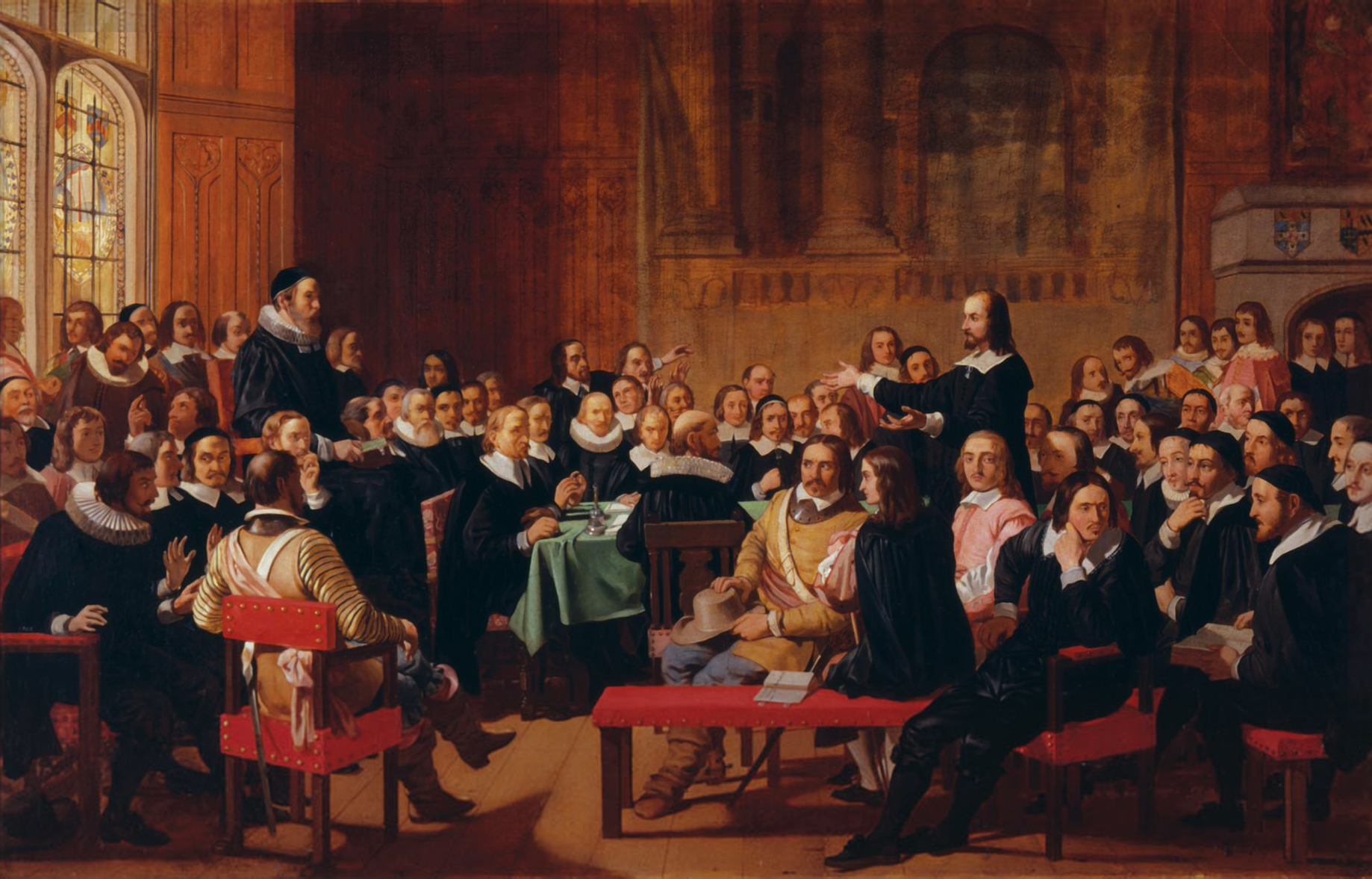
The Westminster Assembly was a 17th century council of English Puritan and Scottish Presbyterian ministers who were tasked with unifying the English and Scottish churches with a shared statement of faith, catechism, system of government, and guidelines for worship. Its confession of faith and catechisms are still the doctrinal standards of Presbyterian churches today.

Today I want to share some of what the assembly said about biblical guidelines for the process of getting married. In evangelical circles in our time, there has been a bit of confusion and discussion about how to respond to the culture of individualism, casual dating, sexual "freedom" that surrounds us. Some have used the term "courtship" to describe a way of getting married that is more purposeful, careful, and respectful of parental authority. While this approach has gone well for some, myself included, in other people's experience the attempt to implement this alternative way has been messy and prone to overreaction, which is why I bring in this historical perspective. Over-reacting and under-reacting are both driven by an unbalanced focus on the present situation. The teachings of the church in other cultures and eras can give us balance, new insights, and the wisdom of experience. So what did the Westminster Assembly have to say about getting married?

First, the Westminster Assembly has a chapter on marriage in its Confession of Faith (chapter 24, see link for biblical footnotes). In short, it affirms that the Bible teaches that marriage is to be monogamous and heterosexual, for mutual help, procreation, and the prevention of immorality. Incestuous marriages cannot be made lawful, and divorce is only lawful in the case of adultery or willful desertion which is unable to be remedied by church and state. Article three of this chapter is particularly relevant for the topic of getting married:
"It is lawful for all sorts of people to marry, who are able with judgment to give their consent. Yet it is the duty of Christians to marry only in the Lord. And therefore such as profess the true reformed religion should not marry with infidels, papists, or other idolaters: neither should such as are godly be unequally yoked, by marrying with such as are notoriously wicked in their life, or maintain damnable heresies." 
Second, the Westminster Assembly described the duties of the seventh commandment (the one against adultery) at length in the Larger Catechism (Q. 137-139). Not only does it describe our duty to be chaste in "body, mind, affections, words, and behavior," but also our duty to preserve our own chastity and the chastity of others. This requires "watchfulness over the eyes and all the senses; temperance, keeping of chaste company, modesty in apparel" - certainly important directions in our present day which exalts pleasure, autonomous freedom, and irresponsible clothing choices. Most importantly for the topic of getting married, it affirms that one duty of the seventh commandment is "marriage by those that have not the gift of continency." If you are of marriageable age, you have a duty to seek marriage, unless you have a special gift of restraint such that sexual temptation is not a threat (1 Cor. 7:2-9; see this post for more on that text). The catechism says that one of the sins forbidden by the seventh commandment is the "undue delay of marriage."

Third, and perhaps most overlooked, is what the Westminster Assembly said about getting married in the Directory for Public Worship (under "The Solemnization of Marriage"). Before the directory gives directions for the wedding ceremony, it gives directions for the process of getting married. Give particular attention to how it handles the consent of the couple and their parents, beginning in the fourth paragraph. In short, the free consent of the couple (Gen. 24:57-58, Mal. 2:14) and of their parents (Ex. 20:12, 22:17, Deut. 7:3) are both needed before the engagement is made public (i.e. they all have ability to veto the marriage), although parents cannot deny their consent without just cause.
"Although marriage be no sacrament, nor peculiar to the church of God, but common to mankind, and of publick interest in every commonwealth; yet, because such as marry are to marry in the Lord, and have special need of instruction, direction, and exhortation, from the word of God, at their entering into such a new condition, and of the blessing of God upon them therein, we judge it expedient that marriage be solemnized by a lawful minister of the word, that he may accordingly counsel them, and pray for a blessing upon them.
Marriage is to be betwixt one man and one woman only; and they such as are not within the degrees of consanguinity or affinity prohibited by the word of God; and the parties are to be of years of discretion, fit to make their own choice, or, upon good grounds, to give their mutual consent. 
Before the solemnizing of marriage between any persons, the purpose of marriage shall be published by the minister three several sabbath-days, in the congregation, at the place or places of their most usual and constant abode, respectively. And of this publication the minister who is to join them in marriage shall have sufficient testimony, before he proceed to solemnize the marriage. 
Before that publication of such their purpose, (if the parties be under age,) the consent of the parents, or others under whose power they are, (in case the parents be dead,) is to be made known to the church officers of that congregation, to be recorded. 
The like is to be observed in the proceedings of all others, although of age, whose parents are living, for their first marriage. 
And, in after marriages of either of those parties, they shall be exhorted not to contract marriage without first acquainting their parents with it, (if with conveniency it may be done,) endeavouring to obtain their consent. 
Parents ought not to force their children to marry without their free consent, nor deny their own consent without just cause. 
After the purpose or contract of marriage hath been thus published, the marriage is not to be long deferred."
And fourth, even though it is not the product of the Westminster Assembly, but of one of its members, I would recommend William Gouge's book, Of Domestical Duties (1622), which has been published in a modern edition as Building a Godly Home, 3 volumes (Reformation Heritage Books, 2014), available here. The topic of getting married is covered in volumes 2 and 3. William Gouge was a senior member of the Westminster Assembly, a Puritan pastor in London, and a married man with thirteen children. His book is worth reading. Here is one quote from him on the process of getting married:
"The first liking is sometimes on the parents' or other friends' part, and then made known to the party to be married ... (Gen. 24:58). Sometimes again the first liking is on the party's part that is to be married, and then if that party be under the authority of parents, the matter must be proposed to them, before there be any further proceeding ... (Judg. 14:2). Even if the party is not under the authority of any, it is very fitting that counsel be taken of wise and understanding friends ... After a liking is thus taken by one party for a good mate, that liking must be proposed to the other party so liked, to know if there is a reciprocal affection of one towards another ... Mutual love and good liking of each other is as glue. Let the parties to be married be well settled before they come to meet with trials through cohabitation, and that love will not easily be loosened by any trials ... When both parties have shown a mutual liking to each other, and upon mature deliberation and good advice do think one to be a fit match for another, it is necessary that a joint consent and absolute promise of marrying one another before sufficient witnesses be made." (Building a Godly Home, vol. 2, p. 17-19)
——————

Update: You can find an excerpt from the sermon of another member of the Westminster Assembly, Thomas Gataker, on seeking a good wife here.

Thursday, November 7, 2019

Who is the Holy Spirit?

The Spirit is not a dove, but once He used the form of a dove to symbolize Himself (Matt. 3:16)

1. The Holy Spirit is God, the same God who is revealed throughout Scripture. The apostle Peter identifies the Spirit as God in Acts 5:3-4. The apostle Paul, in 2 Corinthians 3:17, identities the Spirit as the Lord, and in that context "the Lord" is God, the same God who revealed His glory to Moses. This means that He shares in all the attributes of God: He is eternal, invisible, present everywhere, all powerful, all knowing, perfectly righteous and wise, abounding in steadfast love and faithfulness. 

2. The Holy Spirit is a person, not a force. Jesus described the Spirit in personal terms when He called the Spirit "another Helper," just as Jesus had been a helper (John 14:16-17, 26). The word can mean helper, counselor, or advocate. The Spirit can be lied to (Acts 5:3), which implies a personal relation to the Spirit. The Spirit can also be grieved (Eph. 4:30).  

3. The Holy Spirit is distinct from the Father and the Son. The Spirit is sent by the Father and is “another Helper” compared to Jesus (John 14:16-17), so the Spirit is distinct from both of them, even though the three of them are one God, the same in substance, equal in power and glory. We also see the Spirit distinguished from - and interacting with - the other persons of the Trinity in passages like Jesus’ baptism where He descended upon Jesus in the form of a dove (Matt. 3:16-17).

4. The Holy Spirit proceeds from the Father and the Son. The Son is distinguished as the only one eternally begotten from the Father (John 1:14) and the Spirit is distinguished as the one who eternally proceeds from the Father and the Son. This term comes from John 15:26, where Jesus says, "when the Helper comes, whom I will send to you from the Father, the Spirit of truth, who proceeds from the Father, he will bear witness about me." The Eastern church argues from this that the Spirit only proceeds from the Father, but the Western church has argued that since Scripture also speaks of the Spirit as "the Spirit of his Son" (Gal. 4:6), that the Spirit proceeds from them both. This makes sense, since just as the Son reveals and points to the one from whom He is begotten, the Father (John 1:14, 18), so the Spirit reveals and points to those from whom He proceeds, both the Father and the Son (John 14:26, 15:26, Gal. 4:6). 

5. The Holy Spirit is the giver of life. "For the letter kills, but the Spirit gives life" (2 Cor. 3:6). In both creation and salvation, the Spirit is described as the one who gives life. We get a hint of that when God gives life to man by His breath in Genesis 2:7, since the word for breath and spirit are the same (see also Job 33:4). Psalm 104:29–30 describes God's ongoing work in the order of creation by the Spirit, "When you hide your face, they are dismayed; when you take away their breath, they die and return to their dust. When you send forth your Spirit, they are created, and you renew the face of the ground."

Therefore, it is fitting that the new spiritual life of salvation also comes from the Spirit. We are born again with a renewed nature by the Spirit (John 3:5-6). We are united to Jesus and given eternal life by the Spirit (John 6:54-56, 63). We are delivered by the Spirit from our sinful nature and its rebellious ways unto a new nature defined by virtues like love, peace, and self-control (Gal. 5:16-24). The Spirit gives life to the church, making the body work together in mutual service and binding it to Christ the head (1 Cor. 12:3-7, 12-13). And finally, our bodies will be raised up on the last day by the Spirit (Rom. 8:11). In short, while the Son accomplishes salvation, the Spirit applies these benefits to the elect. 

6. The Holy Spirit reveals God's word to humanity. The Spirit spoke through people and guided them to write down God's word for future generation in the Scripture. The apostle Peter told his readers to pay attention to Scripture, because no prophecy of Scripture came "by the will of man, but men spoke from God as they were carried along by the Holy Spirit" (2 Peter 1:21). And while he had the Old Testament particularly in mind, Peter put apostolic witness on the same level (1:16-19, 3:2) and identifies the apostolic writings as Scripture at the end of his epistle (3:15-16). This is no surprise, since Jesus said that the Spirit would remind the apostles of His words (John 14:25-26), so that the whole Bible is the product of the Spirit's work. 

In connection with this work, the Spirit also gave gifts of healing and miracles to confirm the apostolic message (Heb. 2:4) and gave the gift of speaking in foreign tongues to communicate the inclusion of the Gentiles in the new convent (Acts 2:4-11, 1 Cor. 14:21-22). The new covenant being established and the canon of Scripture being finished with Jesus and His apostles (Heb. 1:1-2, 2:4, 2 Peter 3:2), these particular gifts have ceased with the passing away of the apostles.

Yet, the Spirit continues to work in the hearts and minds of people to enable them to recognize, receive, and understand the written word of God (1 Cor. 2:12–14). The Spirit gives us the ability to believe and obey God's word, not only externally, but also from the heart (Ezek. 36:26-27).

7. The Holy Spirit is essential to the Christian faith and life (Matt. 28:19). Neglecting the Spirit cannot come without fundamentally distorting Christianity. This usually happens by making the faith moralistic, merely formal and external, or a matter of "cold orthodoxy." On the other hand, many people today have a unbiblical understanding of the Spirit's work, isolated from the written word and the work of Christ. This can lead to a dangerous confusion between the Holy Spirit and your inner thoughts and feelings. But a proper appreciation of the Holy Spirit leads to a lively faith and active love in the fellowship of the saints which is guided by Scripture and leads us to appreciate and enjoy the work of Christ and the love of the Father. And so we confess in the historic words of the Nicene Creed of 381:
"And we believe in the Holy Spirit, the Lord and giver of life, who proceeds from the Father and the Son; who with the Father and the Son together is worshipped and glorified; who spoke by the prophets."

Tuesday, November 5, 2019

Join Us for the 2019 Pilgrim Heritage Celebration!


In the video above, I give a brief explanation of why my church hosts an annual event that remembers and celebrates the Pilgrims who settled Plymouth colony. This year's event will be held on the Saturday before Thanksgiving, November 23rd, at the Family Vision Library (2020 Parkway Dr. St Peters, MO 63376). I will be speaking on how we might live today as heirs of the Pilgrims, learning from their example and extending their vision into the future. I will be joined by Jeff Hamann, who will recall the history of the Pilgrims, and Dan Ford, who will speak about the legacy of the Pilgrims in American history. Dan Ford is the author of The Legacy Of Liberty and Property and In the Name of God, Amen: Rediscovering Biblical and Historical Covenants.

The main program will begin at 3:30pm. This will include the talks, as well as music and other fun. Afterwards we will eat together with a delicious Thanksgiving-style dinner, and we will conclude with a 17th-century country dance.

Registration for the event is now open online at this link. Register today at least several days in advance so that we can tell the caterer how much food to bring. Admission is $5 a person, and children 2 years old and under are free. Let me know if you have any questions by using the contact form at this link

For recordings from the last two years of this event, see here and here. You can also read this post that I wrote in preparation for this event last year, explaining why the Pilgrims are worth a celebration. You can also watch the dance that I plan on calling at the end of this year's event at this link

“Lastly, (and which was not least), a great hope and inward zeall they had of laying some good foundation, or at least to make some way therunto, for the propagating and advancing the gospell of the kingdom of Christ in those remote parts of the world; yea, though they should be but even as stepping-stones unto others for the performing of so great a work.”
-William Bradford, Of Plymouth Plantation

Friday, November 1, 2019

Should Christians Keep the Old Testament Feasts?


Because modern Christianity tends to neglect the Old Testament, some have sought to supply this lack by returning to Old Testament practices like the food laws, the seventh-day Sabbath, and at least some of the feasts. It also seems that this movement comes as a radical reaction against the history and tradition of the Christian church. For example, the choice between the traditional church calendar and the Old Testament feasts is seen as a conflict between tradition and biblical truth. This is a bit ironic, because they usually end up adopting Jewish traditions that have continued to develop since biblical times. But it is a powerful appeal, especially to Protestants, and appears to have some truth to it - after all, Sukkoth is in the Bible, but Christmas is not. So should we return to the Old Testament ceremonies and holy days?

In his letter to the saints in Colossae, the apostle Paul wrote,
"Therefore let no one pass judgment on you in questions of food and drink, or with regard to a festival or a new moon or a Sabbath. These are a shadow of the things to come, but the substance belongs to Christ." (Colossians 2:16–17)
This is one of the places in the New Testament which teaches that the old covenant symbolic ordinances and ceremonies are no longer binding on Christians in the present era (for another, see Hebrews 9:9-10, 10:1). Now, I have seen some argue that Paul is here affirming these practices, in effect saying: "do not let anyone condemn you for practicing these things, since they point to Christ." But this is not Paul's point in Colossians. Rather, he is saying, "do not let anyone condemn you for not following these practices, since you already have the substance they pointed to - Christ!" How do I know this? Because the sufficiency of Christ, as opposed to regulations regarding what you can taste and touch, is Paul's theme (Col. 2:6, 20-21). He had already addressed the matter of circumcision, the preeminent symbol of the old covenant administration. He argued that they were already circumcised with a circumcision made without hands by putting off the flesh and being united to Christ, an event confirmed by their baptism (Col. 2:11-12). They were circumcised without being physically circumcised by having the substance, Christ. Therefore, they did not need to be circumcised (cp. Acts 15, Gal. 5:2-6). This pattern holds true for other ceremonial laws of food and times.

The laws regarding clean and unclean foods had been given to represent the purity of God’s people, in distinction from the nations (Lev. 11, Acts 10:9-29). The unclean foods were literally unclean and often unhealthy, but that is not the main reason they were forbidden (just as ritual washings were primarily spiritual in meaning, even though they did physically wash things). The true uncleanness or defilement is sin and curse. The food laws were a shadow, but the substance belongs to Christ. Christ takes away our defilement and makes us clean. In Christ, we are called to avoid the defilement of sin and to be holy. Christ taught us the true meaning of defilement in Mark 7:18-23 when he said,
“‘Do you not see that whatever goes into a person from outside cannot defile him, since it enters not his heart but his stomach, and is expelled?’ (Thus he declared all foods clean.) And he said, ‘What comes out of a person is what defiles him. For from within, out of the heart of man, come evil thoughts, sexual immorality, theft, murder, adultery, coveting, wickedness, deceit, sensuality, envy, slander, pride, foolishness. All these evil things come from within, and they defile a person.’” 
The festivals and new moons were holy times in Israel, observed with sacrifices and often participated in by eating. These also were shadows of Christ. The Passover pointed to Christ, our Passover Lamb (1 Cor. 5:6-13). The Feast of Firstfruits pointed to Christ, who rose as the firstfruits of the dead on that very day (1 Cor. 15). The Feast of Weeks or Harvest (i.e. Pentecost) commemorated blessing in the Promised Land and the giving of the law. It pointed to Christ, who achieved lasting rest in the land (Heb. 3-4) and who sent His Spirit on that day to write the law on our hearts (Acts 2). The Feast of Trumpets prepared the people for the next two events in that seventh month: the Day of Atonement, which pointed to Christ’s atonement for our sins which was achieved on the cross (Heb. 9), and the Feast of Booths, which looked back to God’s provision for Israel in the wilderness and looked forward to Christ, who is the manna from heaven, the bread of life (John 6), and the rock from which comes living water (John 4, 1 Cor. 10). And all the sacrifices on these days and on the new moons pointed to Christ, the once-for-all-time sacrifice which paid the penalty for our sins and reconciled us to God (Heb. 9-10).

Also on this list is “a Sabbath” or “sabbaths.” This probably refers to the sabbath years, as well as the weekly, seventh-day Sabbath. The old covenant Sabbath pointed to Christ and His redemptive work. It was a day of rest, and Christ has given us rest. If we have entered God’s rest in Christ, we have rested from our works (Heb. 4:10). It was also a day that commemorated the accomplishment of redemption. In Deuteronomy 5:15, Israel was commanded to keep the Sabbath in remembrance of their exodus from Egypt. It was then that God rested from the work of redemption and that Israel rested from its bondage. But this pointed to the full accomplishment of redemption in the resurrection of Christ. Thus, the seventh-day Sabbath was a shadow of things to come, but the substance belongs to Christ. And so we do not observe the seventh-day Sabbath of the old covenant, but we follow the example of Christ and the apostles and observe the Lord’s Day as the Christian Sabbath (John 20, Luke 24, Acts 20:7). The Sabbath principle is an aspect of creation and is part of the moral law, but the day has changed because a new creation has begun and something greater than the exodus has come.

Thus, all of these old covenant ceremonies of food and time are no longer required. They were tutors given to bring Israel to Christ before His coming. They were shadows, giving us the outline of the one to come, but now that He has come, we turn from observing the shadows to Jesus Christ. Jesus established new ceremonies that fit the greater clarity of the new covenant, like baptism, the Lord’s Supper, and the Lord’s Day. While the Old Testament feasts are in the Bible, to treat them as holy days, to be observed today as such, is unbiblical.

The Old Testament is important. It is often sadly neglected today. It is still part of the Bible, God's infallible word. But it is vital to understand it and obey it in the light of Christ and the new covenant.

Tuesday, October 29, 2019

The Reformation and the Sufficiency of Scripture

Reformation Day is coming up in a few days on October 31st, and one of the central points of the Protestant Reformation was the doctrine articulated in the quote below. As opposed to the idea that the whole counsel of God was given partially in Scripture and partially in a distinct oral tradition preserved by the church leadership, the Reformers taught that Scripture was sufficient, not lacking any additional revelation to be gained through church tradition, and that Scripture alone remained an infallible rule of faith and obedience. Because the whole counsel of God was given in His written word, and only there preserved infallibly, it could serve as the basis for a reformation of the church and a correction of her doctrines and traditions where they had gone astray.


“All Scripture is breathed out by God and profitable 
for teaching, for reproof, for correction, and for training in righteousness, 
that the man of God may be complete, equipped for every good work.” 
(2 Timothy 3:16-17)

Thursday, October 24, 2019

Our Duty towards Unjust Civil Government

In two recent posts, I have considered the duty of civil government and the duty of the people toward civil government. Here I want to conclude this short series by considering our duty when civil authority is abused. Those in civil government often use their power in unjust ways or ways that go beyond God's intention for civil government, adding additional burdens for those under them. While the civil government ought to be the champion of justice and liberty, sometimes it is the very thing that undermines these principles. So what should we do when the civil government is unjust or overbearing? Here are some things we should do:

1. Focus on serving God in your current condition, rather than fretting. As Paul teaches in 1 Corinthians 7:20-24, be content even when you are in some degree of servitude and serve God by respecting your master. "Were you a bondservant when called? Do not be concerned about it" (1 Cor. 7:21). But seek freedom when you are able. "But if you can gain your freedom, avail yourself of the opportunity ... do not become bondservants of men." (1 Cor. 7:21, 23).

2. Embrace responsibility and act like freemen in spirit. Do not let your condition lead you to lose initiative or become embittered and discouraged. You are a freeman of the Lord (1 Cor. 7:22). Govern yourself, take responsibility for your own, and show mercy to others.

3. Be patient amid injustice - especially as private citizens. Jesus gave us a general rule in Matthew 5:38-42 to not resist the one who is evil, particularly in cases like when someone gives a personal insult, takes your clothes, or impresses you into government service for a mile or two. Note also what Paul says in Romans 12:14-21, "Bless those who persecute you; bless and do not curse them ... Beloved, never avenge yourselves, but leave it to the wrath of God."

4. Repent of your sins and seek mercy from God in prayer. Participate in corporate repentance as a people, confessing not only individual sins, but also societal and national sins. God can use tyrants and oppressors to judge sinners and to chastise His people (Judges 2:11-23), and the intended response is for us to repent and seek His mercy (Jonah 3). And pray also that God might correct injustice and tyranny and save His people from oppression (Ps. 10, 82, 94), appealing to His righteousness and steadfast love.

5. Disciple others in a biblical view of society, justice, and the state (Matt. 28:18-20). This is key to lasting change, particularly when people are transformed by the gospel and desire to honor God in this area. Political campaigns might call people to action, but they cannot replace the formative work of education, gospel transformation, and discipleship.

6. Be involved in politics. Seek reformation with whatever influence you can reasonably exercise. This includes campaigns, protests, petitions, donations, voting, and the like. “Hate evil, and love good, and establish justice in the gate…” (Amos 5:15). A free system of government, like we have here in the United States, gives citizens a large amount of opportunity and responsibility to establish justice and freedom through political involvement. The well-being of your neighbors depends in part upon your political involvement.

7. Challenge unjust actions by legal means. Call a lawyer. Appeal from one authority to another. Paul made this sort of resistance several times (Acts 16:37, 22:25, 28:19). Occasionally strategic law-breaking may be part of such a legal challenge. 

8. Respectfully and firmly disobey if the civil government commands you to sin. Consider the examples of Shadrach, Meshach, and Abednego (Dan. 3), Daniel (Dan. 1, 6) and the apostles (Acts 5). "We must obey God rather than men" (Acts 5:29).

9. Run away when in private danger for just cause. Consider the example of David (1 Sam. 19:12, 20:1, 21:10) and Elijah (1 Kings 19:1-3).

10. Support resistance by another civil authority. Within a system of civil government, there is a variety of authorities, and each civil authority has a particular duty to use force to protect the people under his charge against unjust aggression (Rom. 13:1-5). It is proper for a civil authority to interpose between the people and an unjust ruler. The people as a whole, organized as such, is one of these civil authorities, although private individuals are not. Resistance must not be to civil government itself, but by civil authority to civil authority. We see an example of this imposition in 1 Samuel 14:43-45 when the people stopped King Saul from executing Jonathan, as well as in 2 Chronicles 23 when the priests and the commanders and heads of the people made Joash king and dethroned Queen Athaliah the tyrant. Because this interposition involves resistance with force, it should be subject to just war criteria and used when other remedies have been tried and failed. We see more recent examples of this principle in the English Civil War and the American War for Independence. A less dramatic example of this is when a lower magistrate refuses to enforce an unjust law from a higher authority. 

It is easy to get discouraged when the power of civil government begins to be used for injustice or to expand government control and take away freedom. The is especially the case in our day when an individual seems so small in the grand scheme of things. But to give up in discouragement and bitterness is only to become even more a slave than you were already. There are many things that a person can do, and with the help of others and the blessing of God, change is possible. Our Lord reigns in the heavens and laughs at the pride of even the most powerful tyrants.