Showing posts with label Pilgrims. Show all posts

Friday, November 21, 2025

The Life of William Bradford


William Bradford was the governor of Plymouth for over 30 years and he wrote the most significant history of the colony’s founding, Of Plymouth Plantation. He led the colony with skill and wisdom and he recorded its story for future generations. He was in the best place to write a history, for he had been part of the Pilgrim story from the beginning, and he played a leading part in their lives in the new world. As one biographer has put it, “To [William Bradford], as to most Puritan historians, the writing of history was in the nature of a sacred obligation, for it was the recording of God’s providence as it worked itself out in human affairs” (Perry D. Westbrook, William Bradford). 

Bradford had seen God’s mercy and power at work in the lives of the Pilgrims, as well as in his own life. In some ways, Bradford was an unexpected instrument. He had been weak, despised, and suffering before he came to strength and leadership and prominence. And yet, in these ways, God had providentially prepared him for his calling and blessed the whole colony with a wise and godly magistrate who knew where they came from and where they intended to go. 

Early Life in England

At the end of his life, he wrote a poem about his life. It begins,
From my years young in days of youth,
God did make known to me his truth,
And call'd me from my native place
For to enjoy the means of grace
In wilderness he did me guide,
And in strange lands for me provide.
In fears and wants, through weal and woe,
As pilgrim passed I to and fro…
William Bradford was born in 1590 (1589 O.S.) in Austerfield, Yorkshire, baptized on March 19th. His early years were filled with loss. In 1591, his father died. In 1594 his mother remarried and William was sent to live with his grandfather. In 1596 his grandfather died, and William returned to his mother. In 1597 his mother died and he was sent to be cared for by his uncles, Robert and Thomas. By this point, he was only 7.

William was from a line of yeoman farmers, and his uncles put him to the work of herding sheep. But during this time, William was afflicted by a long sickness. He later saw this as providentially keeping him from the vanities of youth and preparing him for what was to come. It led him to read more, books like Foxe’s Book of Martyrs, Erasmus’ The Praise of Folly, and the Geneva Bible.

The reading of Scripture at about 12 years of age made a strong impression on him, and he became known as a Puritan, enjoying the ministry of Richard Clifton, a Puritan minister in the established church a few miles away in Babworth. As Cotton Mather later said of Bradford: “Nor could the wrath of his uncles, nor the scoff of his neighbors, now turned upon him, as one of the Puritans, divert him from his pious inclinations” (Magnalia Christi Americana). Bradford also met William Brewster, of nearby Scrooby, who became a mentor and father figure to him (Brewster was 23 years older than Bradford).

As a teenage, Bradford studied the question of whether it was right to remain in the parish assembly or whether he should join a separatist congregation that practiced God’s ordinances in their purity. He decided that he must separate, and did so, despite the rage of his friends. Perhaps he first joined the separatist congregation in Gainsborough, but then he joined the closer one that formed in Scrooby, formally organized in 1606 with Richard Clifton as its pastor and John Robinson as its teacher (later William Brewster became its ruling elder).

This separatist congregation soon attracted the hostility of the authorities, and so they tried to leave England. Some of them were caught trying to leave in 1607 and imprisoned, including 17-year-old William Bradford. By 1608, he and the others had made it to the Netherlands.

Becoming an Adult in the Netherlands

In Amsterdam, William Bradford learned from and served a Frenchman in the working of silks. The French were rather skilled in the textile industry, and it was Huguenot refugees from France who later brought improvements to this industry to northern Ireland and elsewhere. William Bradford also enjoyed the fellowship and worship of the separatist church and moved in with the Brewster family and stayed with them until he got married in 1613.

After about two years in Amsterdam, the church moved to Leyden to avoid being drawn into conflicts in other separatist congregations. In Leyden, Bradford worked as a fustian-worker (a weaver of a heavy cotton-linen fabric used for men’s clothing). He knew many languages: English, Dutch, French, Latin, and Greek. Later in life, he also learned Hebrew to read the Old Testament in its original language.

In 1611, Bradford turned 21 and was able to receive his inheritance. He converted his estate into money and set himself up in Holland with a house and loom of his own. He also probably helped the church buy a building for a meeting space. In 1613, he married Dorothy May, the daughter of an elder of another separatist church. Their son John was born in 1617.

He and his wife joined the group that set out for the new world in 1620, leaving behind their 3-year-old son in the care of others until it was safer for him to come over.

Governor in Plymouth

When they arrived in the new land, William Bradford signed the Mayflower Compact and went on several expeditions to explore the land. On the first expedition, he was caught by a deer trap and hanged upside down until his friends were able to free him. Tragically, his first wife died by falling overboard while Bradford was away on one of these expeditions.

In that first winter he was struck with a great pain in his hip and collapsed, and it was thought he would not last the night. He was cared for by Captain Standish and Elder Brewster, two of only six or seven who remained well enough to care for the others. While Bradford was sick, the common house where he was staying caught fire, but he and the others in it escaped.

When Governor Carver died in April, the 31-year-old Bradford was unanimously chosen to be the new governor of the colony, even though he had not entirely recovered from his illness. He would be re-elected 31 times to one-year terms, serving as governor every year of his remaining life except for five. As Cotton Mather later remarked, “He had, with a laudable industry, been laying up a treasure of experiences, and he had now occasion to use it: indeed, nothing but an experienced man could have been suitable to the necessities of the people.”  

Marriage and Family

In 1623, William Bradford married a second time. His second wife was a widow with two children named Alice. It appears he had courted her by letter before she arrived, so that they married soon after her arrival. Their wedding was attended by Massasoit, his queen, four other kings, and 120 of his men. These guests also brought three or four bucks and a turkey for the feast. The colonists and Indians feasted together and the Indians danced for their English friends. William and Alice went on to have two sons and a daughter.

His Time as Governor

On aspect of being governor was maintain good foreign relations with the native tribes. Several examples can be produced from just his first year in office. He sent out a party to rescue Squanto from Corbitant, a Wampanoag sachem. He sent another party to establish the fur trade with the Massachusetts. He also made a show of strength when the Narragansetts sent a threatening message of arrows tied in a snakeskin. Bradford sent back powder and balls in that snakeskin with the message: “that if they had rather have warre then peace, they might begine when they would; they had done them no wrong, neither did they fear them, or should they find them unprovided.” He also enforced a policy of only obtaining lands from the Indians by voluntary purchase.

Bradford also had to deal with debt and property. Plymouth colony was originally organized as a joint-stock company. All property belonged to the company and was held in common. The distribution of property and debts had the potential to provoke jealousy in the colony. In 1622, when new comers arrived who did not share the burden of the company, Bradford wisely came up with an arrangement to keep the peace. In 1623, he consented to a division of the land and oversaw its distribution, so that each household could work its own land and simply pay a tax. In 1627, Bradford oversaw the end of the joint-stock company by the settlers purchasing the colony from the London merchants. Each “purchaser” received shares of the debt and a certain amount of land to own. To make repaying the debt easier, a group of 11 men (including Bradford) known as the “undertakers” took on the obligation to pay the colony’s debt and received a monopoly on trade with the Indians. The undertakers were also able to arrange for the transport of the remaining Leyden separatists. It took them 14 years to be free of the debt. Further skill was required for Bradford and his assistants to oversee the distribution of land to more newcomers and eventually to turn this power over from the original purchasers to all the freemen of the colony in 1641.

There were also troublesome men who had to be dealt with. The most serious threat came early on in 1623-1624 with the arrival of two men, the hypocritical minister John Lyford and the hotheaded John Oldham. They pretended friendship, but worked secretly to pit newcomers against the established leadership, and to pit those in England against the separatists in Plymouth. Bradford intercepted their slanderous letters to England and produced copies of them at the right time so that these men were exposed. Oldham had already mistreated Captain Standish, and when the letters were produced, Lyford was silenced while Oldham tried to lead an uprising. They were banished from the colony (they later learned that Lyford had a scandalous past that further exposed his wretched character).

Religion in the colony was another important matter. William Bradford rejoiced to hear of the downfall of the bishops in England during the time of the English Civil War. Yet he was distressed to see a rise in groups that followed errors. Late in life he wrote a poem on this theme, writing against the Familists, Ranters, Seekers, Levelers, Quakers, Anabaptists, Anti-Trinitarians, Arminians, Roman Catholics, and English Bishops, with an appeal to the Presbyterians to join with the Congregationalists in opposing these errors. Some of these groups even made it to his beloved Plymouth colony. While Plymouth colony was rather moderate compared to the other Puritan colonies with respect to church-state relations and in tolerating disagreement, Bradford knew that the governor was called to be a nursing father to the church and was to support and nourish religion. He had learned from the writings of Peter Martyr Vermigli that both tables of the law were committed to the power of the magistrate, who was to require the people to live well and virtuously. In 1645, a petition was presented to the General Court “To allow and maintaine full and free tolerance of religion to all men that would preserve the Civill peace”. Bradford argued against it and used his position as governor to keep the petition from coming to a vote. In 1655, he threatened to resign as governor unless the General Court took speedy action to “remedy the neglect of competent maintenance for the ministry and the failure to take measures for the suppression of error” (Langdon, Pilgrim Colony, p. 67). A law was passed that ensured a minister’s support by his congregants if they obstinately refused to fulfill their duty. In 1656, at the last General Court that Bradford attended, a Quaker was found guilty of disturbing public worship and of slander and was sentenced to be banished after the winter was over.

His Writings

Bradford had reason to be worried over the religious unity, orthodoxy, and piety of the colony, but not all his efforts were political. He also put pen to paper to leave behind a testimony for future generations.

Between 1630 and 1650, he wrote Of Plymouth Plantation. In this book, he traced the history of the colony from its beginnings in the congregation at Scrooby all the way to 1647, unto the praise of the Lord who had shown his mercy and power. This book remained unpublished, but it was used by other early historians of New England like Bradford’s nephew Nathaniel Morton, who copied portions from Bradford in his book New England’s Memorial. Bradford’s book was kept in Boston, taken by the British in 1776, and was rediscovered in London in 1855.

Bradford also wrote three “dialogues” (1648, 1652) to pass on the vision of the founders to the younger generation, as well as a number of other poems (1650-1657).

His Death

Finally, in 1657, after telling his friends of the comfort he had experienced from the Spirit, he died on May 9th, in the 69th year of his age. His He had done his part and he left the work to future generations.

We have reason to be thankful for what God did through William Bradford. We should also listen to Bradford’s history and exhortation as we press on in our day. 

His will and the inventory of his belongings (including many of his books) at his death can be found here. In his will, he wrote, "In speciall I Commend to you a little booke with a blacke cover wherin there is a word to Plymouth a word to Boston and a word to New England with sundry usefull verses". Here is the word to New England that he mentioned:
A Word to New England, by William Bradford

Oh New England, thou canst not boast;
Thy former glory thou hast lost.
When Hooker, Winthrop, Cotton died,
And many precious ones beside,
Thy beauty then it did decay,
And still doth languish more away.
Love, truth, goodness, mercy and grace—
Wealth and the world have took their place.
Thy open sins none can them hide:
Fraud, drunkenness, whoredom and pride.
The great oppressors slay the poor,
But whimsy errors they kill more.
Yet some thou hast which mourn and weep,
And their garments unspotted keep;
Who seek God's honor to maintain,
That true religion may remain.
These do invite, and sweetly call,
Each to other, and say to all;
Repent, amend, and turn to God,
That we may prevent his sharp rod.
Yet time thou hast; improve it well,
That God's presence may with ye dwell.


Thursday, November 28, 2024

Books on the New England Puritans

Pilgrims Going To Church by George H. Boughton

The New England Puritans make for a fascinating study. I think what they attempted was noble, that they succeeded more than many realize, and that their decline was both due to weaknesses in their system (e.g. being Congregationalist rather than Presbyterian) and to the free choices made by some of their descendants to depart from the path. Here is an annotated bibliography of the best books I have read about them over the years, beginning with books primarily covering 17th century history and ending with books covering 18th century history.

A Reforming People: Puritanism and the Transformation of Public Life in New England by David D. Hall

I really enjoyed reading this book by David D. Hall, professor of New England church history at Harvard Divinity School (three of his books are listed here). It contains a careful look at how the New England Puritans transformed public life by implementing the biblical teachings, reforms, and ethic they had developed in their preaching and teaching. It was a good book on a historical level, giving a better understanding of our American roots and the development of our society, as well as on an applied theology level, giving an example of a society that took seriously the imperative to submit itself to Christ the King and his revelation, the Bible. Rather than moving toward a cruel and authoritative oligarchy (as some would portray it), Puritan society in New England fostered community participation and checks on any potentially “arbitrary” government power. The details of their reforms and practices as they were hammered out in the new world is quite interesting and inspiring.

Worlds of Wonder, Days of Judgment: Popular Religious Belief in Early New England by David D. Hall

This book is not as memorable as A Reforming People, but it was another good book by the same author, with a focus on the religion practiced by the people in early New England, how the theology taught in their books was practiced. As Edmund Morgan says in his review of this book, “[Hall] shows us, as never before, how the sophisticated doctrines of the Puritan clergy meshed, clashed, and merged with the inherited attitudes and assumptions of ordinary people in their day-to-day grappling with the mysteries of their world.” 

The Faithful Shepherd: A History of the New England Ministry in the Seventeenth Century, With a New Introduction by David D. Hall

One takeaway from this book is that New England churches were most radically Congregationalist in the 1630s and that from that time there was tension between those who defended that system and those who sought to modify it toward Presbyterianism. I find that the history of the New England Puritans shows that their heirs are not only found in modern Congregationalist churches, but also in Baptist and Presbyterian churches (the directions these two wings of Congregationalism tended toward).

I have admiration for the New England Puritans, but a consistent takeaway I draw from studying them is an appreciation for Presbyterianism. As Charles Hodge noted in the 19th century, “Had New England, with her compact and homogenous population, and all her other advantages, enjoyed the benefit of a regular Presbyterian government in the church, it would, in all human probability, have been the noblest ecclesiastical community in the world.”

The Puritan Dilemma: The Story of John Winthrop by Edmund S. Morgan

An excellent little book that not only tells the story of John Winthrop, but in telling it, lays out the Puritan mission and dilemma, to seek purity without retreating from society. I seem to remember a few brief passages where the author might have misrepresented or overly simplified the theology of the Puritans, but taking those comments with a grain of salt, the book is worth reading. Morgan was a professor of history at Yale, and three of his books are listed here.

The Puritan Family: Religion and Domestic Relations in Seventeenth-Century New England by Edmund S. Morgan

The Puritans took quite seriously the idea that the household is basic to human society. This book is an interesting look into the family life and household structure of the New England Puritans, including the relationships of husbands and wives, parents and children, and masters and servants. (Another book I have but which I have not read cover to cover is a similar book covering family life in Plymouth Colony in particular, A Little Commonwealth: Family Life in Plymouth Colony by John Demos.)

New England Frontier: Puritans and Indians 1620-1675 by Alden T. Vaughan

An excellent book on the New England Pilgrims and Puritans and their interactions with the native peoples by Alden T. Vaughn, a professor of history at Colombia University (I have the third edition, published in 1995). I came across this book while researching missionary efforts to the native tribes of New England, since it spends three chapters on that subject. It traces the relationships of the colonies to the tribes in other respects as well, from the founding of Plymouth in 1620 to King Philip’s War in 1675. (Two other books I found helpful on Puritan missions were The Theology of Puritan Missions by Rooy and The Puritan Hope by Iain Murray.) 

Anne Bradstreet: A Guided Tour of the Life And Thought of a Puritan Poet by Heidi L. Nichols

My wife and I read this book while we were expecting our daughter Anne. Later I found out that I am descended from Anne Bradstreet. This book gives a helpful overview of Anne’s life and context as well as her writings, many of which are included in the book (both of her poetry and her proverbs). This is probably the best single book to get on Anne Bradstreet, but another biography with greater focus on her life and character is Beyond Stateliest Marble by Douglas Wilson (also published as Anne Bradstreet: Passionate Femininity), and a good biography for younger readers is Anne Bradstreet by Simonetta Carr.

William Brewster of the Mayflower: Portrait of a Pilgrim by Dorothy Brewster

A helpful and informative biography of a man who lived an eventful life - a Cambridge education, service abroad under Queen Elizabeth, Postmaster and Bailiff of Scrooby Manor, outlaw printer in Holland, and elder of the Pilgrims’ church. This book mostly tells of Brewster's life leading up to the Mayflower. I also have another biography of Brewster which I have not yet read but have heard recommended, Pilgrim: A Biography of William Brewster by Mary B. Sherwood.

Pilgrim Colony: A History of New Plymouth 1620-1691 by George D. Langdon

A helpful history of Plymouth colony from its founding in 1620 to its annexation to Massachusetts in 1691. While many accounts of Plymouth’s history focus only on its beginning, it was nice to see the full history of the colony laid out. Another less academic history of Plymouth which I have partly read is Samuel Eliot Morrison’s, The Story of the “Old Colony” of New Plymouth. Of course, William Bradford’s history of the colony up to 1646, Of Plymouth Plantation, is an important classic. I have the edition edited by Samuel Eliot Morrison. For more on the founding of that colony, you can get Mourt's Relation, an account first printed in 1622, from Applewoods Books. 

Puritans at Play: Leisure and Recreation in Colonial New England by Bruce C. Daniels

An interesting look into how the Puritans viewed and practiced leisure and recreation. While they placed limits on play, they still had fun within those limits. And even as those limits expanded later in the colonial period, they continued to be influenced by the original principles of practicality and moral restraint.

Jonathan Edwards: New Biography by Iain H. Murray

I have read many of Iain Murray’s books and I have appreciated each one. This biography of Jonathan Edwards was no exception. And in the life of Jonathan Edwards, we learn more about what happened to New England Puritanism in the 18th century.

The Gentle Puritan: A Life of Ezra Stiles, 1727-1795 by Edmund S. Morgan

An interesting book for its insight into 18th century New England from the perspective of the history of Ezra Stiles, a Congregationalist minister and president of Yale College. This book continues the story of New England from the Great Awakening through the American Revolution to 1795. As the author says in his preface concerning Ezra Stiles, “his intellectual curiosity was omnivorous, and precisely because his mind was more receptive than creative, this book is as much a study of the times as it is of the man.” The book also provides another perspective on Edwards, and especially his successors, since Stiles was usually on the other side. I would like to read a book on Stiles' successor at Yale, Timothy Dwight IV, but I have not done so yet. [2025 update: I have now read New England's Moral Legislator: Timothy Dwight, 1752-1817, which was helpful.]

Connecticut’s War Governor: Jonathan Trumbull by David M. Roth

I did not know much about Governor Trumbull until we visited his hometown, Lebanon, CT, which is where I got this book. He was a vital figure during the American War for Independence and a man firmly rooted in New England's Puritan heritage. 

“Day after day, through personal tragedy, and through news of military defeat, financial chaos, and political confusion at Philadelphia, Jonathan Trumbull sat at his desk in the 'War Office' and turned out the directives, and occasionally pleas, that kept the Connecticut war effort functioning until ultimate victory was achieved. The old man came to be something of a comic figure to the sophisticated visitors, especially the French, who passed through Lebanon during the war. Remarks were made about the short, unimposing governor whose conversation was saturated with biblical exhortations. Yet, the smiles never lingered very long, for this Old Testament patriarch never appeared very anachronistic when the time came for performance. His quotas were always filled on time. He was the man to whom Washington turned when the shaky Continental Army was on the point of dissolution.” (p. 65)

[2025 update: This year, the 250th anniversary of 1775, I read two good books on the beginning of the American War for Independence in Massachusetts: The Minutemen and Their World by Robert Gross and Paul Revere's Ride by David Hackett Fischer.] 

The Pioneers: The Heroic Story of the Settlers Who Brought the American Ideal West by David McCullough

One important aspect of studying the New England Puritans is that their legacy is not only to be found in New England, but also in other parts of the USA, especially the Midwest. My own New England ancestors moved west over the generations to Wisconsin. This book tells the story of the settlers who came from New England to settle the Northwest Territory, and in particular, the town of Marietta, Ohio.

Tuesday, November 26, 2024

Our Errand in the Wilderness

The Mayflower in Plymouth Harbor by William Halsall

It was April 5th, 1621. The winter was over and a new year had just begun, for in those days the year began on March 25th. A few weeks earlier, on March 16th, the Pilgrims had made contact with the Wampanoag and over the next week or two they had established a treaty with them, making friends with Samoset, Squanto, and Massasoit. The deadly illness that had plagued them for months was beginning to lift. Nevertheless, they had reached a point of decision. The Mayflower, their ship, was about to depart. The Mayflower had stayed extra long because of their difficulties and insecurity. But now it was time for the ship to return. Half of their people had died. They were not guaranteed a better winter the next time around. Would they stay or would they return on the Mayflower?

None of the passengers returned on the Mayflower. This small group of 52 people remained - without a ship - in their little village on the coast of New England. Why were they there? Why did they stay? Why had they ventured everything on this settlement?

This was the same question asked 50 years later by Samuel Danforth, the pastor in Roxbury, Massachusetts. In 1670 he preached a memorable election day sermon entitled, “A Brief Recognition of New-England’s Errand into the Wilderness” (available online here). What was their errand in the new world? What was the purpose of their settlement? Why did the founders of New England, Pilgrims and Puritans, go out into the wilderness and remain there? He took his text from Matthew 11:7-10 where Jesus spoke of John the Baptist. 
And as they departed, Jesus began to say unto the multitudes concerning John, What went ye out into the wilderness to see? A reed shaken with the wind? But what went ye out for to see? A man clothed in soft raiment? behold, they that wear soft clothing are in kings' houses. But what went ye out for to see? A prophet? yea, I say unto you, and more than a prophet. For this is he, of whom it is written, Behold, I send my messenger before thy face, which shall prepare thy way before thee.
This was Danforth's main point:
Such as have sometime left their pleasant Cities and Habitations to enjoy the pure Worship of God in a Wilderness, are apt in time to abate and cool in their affection thereunto: but then the Lord calls upon them seriously and throughly to examine themselves, what it was that drew them into the Wilderness, and to consider that it was not the expectation of ludicrous levity, nor of Courtly pomp and delicacy, but of the free and clear dispensation of the Gospel and Kingdome of God.
Having explained this doctrine, he began to apply it, with its first use being: 
Use 1: Of solemn and serious Enquiry to us all in this general Assembly, Whether we have not in a great measure forgotten our Errand into the Wilderness. You have solemnly professed before God, Angels and Men, that the Cause of your leaving your Country, Kindred and Fathers houses, and transporting your selves with your Wives, Little Ones and Substance over the vast Ocean into this waste and howling Wilderness, was your Liberty to walk in the Faith of the Gospel with all good Conscience according to the Order of the Gospel, and your enjoyment of the pure Worship of God according to his Institution, without humane Mixtures and Impositions.
It is incumbent us, their heirs, to make a similar enquiry. Have we forgotten our errand in the wilderness? Have we been true to our godly heritage?

What Danforth said of New England generally was indeed true of the Pilgrims in particular. William Bradford listed several reasons they decided to leave Holland, including the coming war with Spain and economic hardship, but the first reason went beyond these to the bigger picture: 
And first, they saw and found by experience the hardness of the place and country to be such as few in comparison would come to them, and fewer that would bide it out and continue with them … For many, though they desired to enjoy the ordinances of God in their purity and the liberty of the gospel with them, yet (alas) they admitted of bondage with danger of conscience, rather than to endure these hardships … But it was thought that if a better and easier place of living could be had, it would draw many and take away these discouragements. (Of Plymouth Plantation)
Thus, the difficulties of life in Holland were not just a hinderance to their comfort, but a hinderance to their mission of building a community that enjoyed the ordinances of God in their purity and the liberty of the gospel. They were not persecuted in Holland, but due to economic, political, and cultural pressures, they were in danger of shrinking and scattering. These difficulties also kept other English Puritans from joining them. But in the new world, as an English colony in the wilderness, they had the opportunity to build a place where others might come from England and join them, practicing freely the principles of God’s word.

Many Puritans desired a further reformation of church and society, but were held back from it in England. If the Pilgrims established this reformation in New England, in a land where they could make a good living, be secure from foreign conflicts, and create an English society reformed by God’s word, then these Puritans could come and join them. The settlement of a new land would certainly be more difficult in the short term, but the opportunities were much greater and the long term prospects much brighter than in Holland.

Indeed, this is what happened! The Pilgrims arrived in Plymouth in 1620. In 1630, John Winthrop and his fleet arrived in Boston harbor, bringing 1,000 Puritans. By 1640, about 20,000 Puritans had come to New England. Their background differed from the Pilgrims, but their basic intention was the same: to complete the reformation and enjoy the purity of God’s ordinances and the liberty of the gospel. In 1643, Plymouth and the other Puritan colonies joined a federation and declared, “we all came into these parts of America with one and the same end and aim, namely to advance the kingdom of our Lord Jesus Christ and to enjoy the Liberties of the Gospel in purity with peace.”

Therefore, William Bradford said concerning the arrival of the Puritans in 1630, 
Thus out of small beginning greater things have been produced by His hand that made all things of nothing, and gives being to all things that are; and, as one small candle may light a thousand, so the light here kindled hath shone unto many, yea in some sort to our whole nation; let the glorious name of Jehovah have all the praise. (Of Plymouth Plantation)
In fact, when Bradford was writing, “our whole nation” of England (at least, as represented by its parliament) had embraced Puritanism, corrected the tyranny of the king, and had called the Westminster Assembly to reform the church. This brought great joy to the Pilgrims. Bradford wrote in 1646: 
Do you not now see the fruit of your labors, O all ye servants of the Lord? that have suffered for His truth, and have been faithful witnesses of the same, and ye little handful amongst the rest, the least amongst the thousands of Israel? … But thou wilt ask, ‘What is the matter? What is done?’ … The tyrannous Bishops are ejected, their courts dissolved, their canons forceless, their service cashiered, their ceremonies useless and despised, their plots for popery prevented, and all their superstitions discarded and returned to Rome from whence they came, and the monuments of idolatry rooted out of the land … Hallelujah! (Of Plymouth Plantation)
Unfortunately, that full national embrace of Puritanism was short lived in England. But what Bradford celebrated would endure in New England, as well as in Scotland. And the influence of New England Puritans and Scots-Irish Presbyterians would spread throughout what would become the United States of America.

In application, let us first consider whether we have we forgotten our errand? Have you forgotten? Has our nation forgotten? Have we neglected our privileges, blessings, and heritage? Have we forgotten the importance of "our Liberty to walk in the Faith of the Gospel according to the Order of the Gospel, and our enjoyment of the pure Worship of God according to his Institution"?

Secondly, let us attend and prosecute our errand into the wilderness! We did not come to see a reed shaking in the wind. Therefore do not be such a reed - light, empty, and limp - but be “solid, serious and sober Christians, constant and stedfast in the Profession and Practice of the Truth, Trees of Righteousness, the planting of the Lord, that he may be glorified, holding fast the profession of our Faith without wavering” (Danforth). Nor did we come for courtly pomp and soft clothing. Therefore do not be soft, immodest, or vain, but rather humble, respectable, and self-controlled. 

Instead, we came into the wilderness, as the people did in the days of John the Baptist, for “the pure and faithful Dispensation of the Gospel and Kingdom of God” (Danforth). This is a worthy thing to seek. Jesus said, “seek first the kingdom of God and his righteousness, and all these things will be added to you” (Matthew 6:33). This kingdom is established and administered by Christ’s ordinances, which he makes effectual by his Spirit for the gathering and perfecting of the saints (Matt. 20:18-20, see also WLC 45, 191). As Christ reigns by his grace, his people serve him in their ways and callings, so that families and societies operate more and more according to God's word. Christ's claims are universal, and everyone ought to submit to his reign and promote his reign according to their place and station. Let us arise and build, and seek the Lord’s blessing.

The Puritans spoke much of the ordinances of God and of keeping them pure and observing them diligently. These ordinances included prayer, singing psalms, the reading and preaching of Scripture, the sacraments of baptism and the Lord's Supper, catechizing, biblical church government, collection for the poor, and the observance of the Christian sabbath. God works by these means, and by them Christ builds and administers his kingdom. They are to be kept unmixed with human innovations and used with faith, a faith which embraces the promises and obeys the commands.

Thirdly, let us also give thanks to God for this good heritage. Be grateful for these forefathers and their sacrifices. Throughout our country’s history, the purposefulness of these forefathers has been an inspiration and a corrective. You and I have benefitted from their work. Our whole country has been blessed by their perseverance. Praise God for giving them such a zeal for his kingdom. May he give us a similar zeal and may he call back our countrymen to the faith of our fathers.

Friday, November 4, 2022

The Life of William Brewster


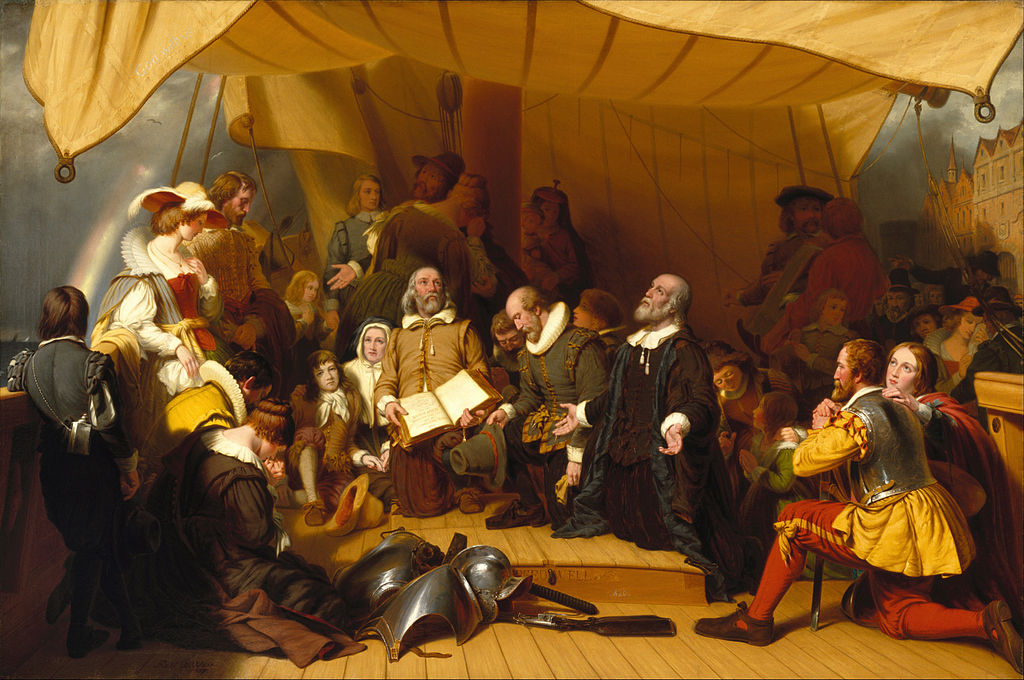
Embarkation of the Pilgrims by Robert Walter Weir 

Birth and Early Years

William Brewster was born in c. 1566. This was twenty years after Martin Luther died, two years after John Calvin died, and six years before John Knox would die. The early stages of the Reformation was over, and now various nations were seeking to implement its implications in church and society. What had started as a debate about justification now was impacting liturgy, church government, and politics. 

William Brewster grew up in a family that was well connected to the times. His father, also named William Brewster, was the bailiff of Scrooby Manor, a manor that belonged to the archbishop of York. The estate included a manor-house surrounded by a moat, a chapel, bake-house, brew-house, gallery, barns and stables, farmland, and the archbishop’s offices. His father had also been appointed in the Queen’s service as the keeper of the post at Scrooby. This role as postmaster, though, did not consist of sorting mail. It consisted in the running of a tavern and inn and keeping a change of horses for official courtiers. The manor was on the Great North Road, going from London to Edinburgh. This manor was close to Sherwood forest, near Nottingham, and royalty still loved to hunt in those woods, just as in the days of Robin Hood.

Education

The Brewster family was able to send their son to Peterhouse College at Cambridge University  in 1580 when he was about 14 years of age. At that time, Peterhouse College was designed to train clergy and “enlightened and competent statesmen and administrators.” Brewster was probably training to be a government official like his father. His time at Cambridge was important, for it was there that Brewster was “first seasoned with the seeds of grace and virtue” (Bradford). Cambridge University had fueled the English Reformation. Cambridge was the place where many reformers were trained and where many taught. The White Horse Inn, where men like Tyndale, Bilney, and Latimer had discussed theology, was in Cambridge. William Perkins, whose writings the Pilgrims prized, was also studying at Cambridge at this time. The Pilgrims' first four pastors, including John Robinson, were all trained at Cambridge. The Puritans prized learning, especially the study of Scripture. Here Brewster would learn Latin and some Greek, but his first application of this learning was not in the church, but in the colorful adventures of Sir William Davison. 

Political Service

Sir William Davison was Secretary of State to Queen Elizabeth, and he took on William Brewster as an assistant. For three years, Brewster followed Davison in Scotland and Holland, assisting him in matters of greatest trust and secrecy. At the time, Brewster was in his late teens. At one point, Brewster was given the keys of a Dutch city that Davison had been given on behalf of the Queen. At another point, Davison gave Brewster a golden chain he had been given to wear as they rode through London. In the end, Davison was used as a scapegoat after the execution of Mary Stuart and was imprisoned for a time in the Tower of London. William Brewster assisted him during this time. Thus, it seems that Brewster was living in London when Sir Francis Drake defeated the Spanish Armada in 1588.

Life at Scrooby Manor

In 1589, at the age of 23, William Brewster was back in Scrooby, assisting his father in his role. The next year his father died, and Brewster become the new bailiff and master of the Queen’s post. The next year, he married Mary Wentworth, whose father had also been the bailiff at one point. And so at age 25, William Brewster had received a good education in the university and by experience in the world and he had a good position in a busy estate with good connections, serving as an official of the archbishop and the Queen. He and his wife would have several children in the years to come: Jonathan (b. 1593), Patience (b. 1600), Fear (b. 1606), Love (b. 1611), and Wrestling (b. 1614). It seemed like he was living the English version of the American dream. 

Yet, in 1606, things would change. The ideas of the Puritans which he had picked up at Cambridge continued to work in his mind. He likely heard of the struggles of his classmates, some of whom had sought to reform the church. A few of them had broken away from the church of England. Like many others in that day, he began to be dissatisfied with the low condition of religion and insufficient reforms in worship and church government. At first, he used his position to promote reformation on a local scale. He set a good example, exhorted his people, and promoted good preachers. But when some people in his region decided to break away and form a church of their own, he offered his manor as a meeting place and joined them. This would become the congregation of the Pilgrims.

This choice had enormous repercussions upon his career. He was soon fined for not attending the established church and he had to resign his position as postmaster. Soon, he was being called to court on the charge of "Brownisim," that is, separatism. Some of the more radical sort of Brownists had been executed for what was seen as subversive activity. Brewster did not stay to find out his end. He did not appear at court. It was soon evident that the congregation would be more free in Holland than in England.

Thus, in two years, William Brewster had gone from a prosperous official, operating a tavern and manor, to a refugee, fleeing with his family and a separatist congregation to Holland.

Life in Holland

Not only did Brewster join the separatist congregation, but he also became a ruling elder in that church after they arrived in Holland. While living in Leiden, he found a job teaching English to the university students in that town. In 1616, he and Thomas Brewer and Edward Winslow set up a publishing operation at Brewster's house. They published books that promoted the reform of the church and criticized the errors of the Church of England, books that were they to be smuggled into England. They also published two books by David Calderwood, a Scottish Presbyterian who criticized the Perth Assembly and King James' attempt to roll back Presbyterianism in Scotland. This caught the king's attention, and Brewster had to lay low for a while to escape the king's men. 

Mayflower, Plymouth Colony

When the congregation began to consider leaving Holland and beginning a colony in North America, William Brewster spoke in favor of the idea. He began to assist with the negotiations with the officials in London, but then as he sought to avoid arrest, he handed over these duties to others. When the Pilgrims finally left on the Mayflower in 1620, William Brewster was 54 years old. During the first winter in Plymouth, he served both the religious and physical needs of the settlers. As William Bradford recounts, 
“And of these in the time of most distress, there was but 6 or 7 sound persons, who, to their great commendations be it spoken, spared no pains, night nor day, but with abundance of toil and hazard of their own health, fetched them wood, made them fires, dressed them meat, made their beads, washed their loathsome clothes, clothed and unclothed them; in a word, did all the homely and necessary offices for them which dainty and queasy stomachs cannot endure to hear named; and all this willingly and cheerfully, without any grudging in the least, shewing herein their true love unto their friends and brethren. A rare example and worthy to be remembered. Two of these 7 were Mr. William Brewster, their reverend Elder, and Myles Standish, their Captain and military commander, unto whom my self, and many others, were much beholden in our low and sick condition.”
Elder Brewster

Since their pastor, John Robinson, remained with part of the congregation in Holland, William Brewster was the only church officer in Plymouth from 1620 until they successfully called a pastor in 1629. He continued to serve as a ruling elder until his death, and remained a rock of stability when the first couple pastors did not stay long and various controversies arose in the church. William Bradford said of Elder Brewster's ministry, 
“he would labour with his hands in the fields as long as he was able; yet when the church had no other minister, he taught twice every Sabbath, and that both powerfully and profitably, to the great contentment of the hearers, and their comfortable edification; yea, many were brought to God by his ministry. He did more in this behalf in a year, than many that have their hundreds a year do in all their lives.”
Bradford praised Elder Brewster's leadership in teaching, prayer, and church government. 
“In teaching, he was very moving and stirring of affections, also very plain and distinct in what he taught; by which means he became the more profitable to the hearers. He had a singular good gift in prayer, both public and private, in ripping up the hart and conscience before God, in the humble confession of sin, and begging the mercies of God in Christ for the pardon of the same. He always thought it were better for ministers to pray oftener, and divide their prayers, then be long and tedious in the same (excepts upon solemn and special occasions, as in days of humiliation and the like). His reason was, that the hearts and spirits of all, especially the weak, could hardly continue and stand bent (as it were) so long towards God, as they ought to doe in that duty, without flagging and falling of. For the government of the church, (which was most proper to his office,) he was carful to preserve good order in the same, and to preserve purity, both in the doctrine and communion of the same; and to suppress any error or contention that might begin to rise up amongst them; and accordingly God gave good success to his endeavors herein all his days, and he saw the fruit of his labors in that behalf.”
Conclusion 

William Brewster established a farm in nearby Duxbury in 1632, and his son Love would acquire a farm next door a few years later. William Brewster died peacefully in 1644, nearly 80 years of old. Included among his belongings were a violet coat, black silk stockings, a doublet, caps, pistol, rapier, and a tobacco case. He also had over 400 books, inventoried here, including books by Luther, Calvin, Beza, Erasmus, Thomas Cartwright, William Perkins, Machiavelli, Francis Bacon, as well as books on geography, silkworms, and medicine (62 of the books were in Latin and 302 of them were in English).  

William Brewster sacrificed much over the years and held fast to his principles. Though he had moved in influential circles, he was not haughty, but associated with the lowly. He served faithfully as an elder, shepherding his people amid many and various difficulties. As his younger contemporary recounted, William Brewster was
“a man that had done and suffered much for the Lord Jesus and the gospels sake, and had bore his part in well and woe with this poor persecuted church above 36 years in England, Holland, and in this wilderness, and done the Lord and them faithful service in his place and calling. And notwithstanding the many troubles and sorrows he passed throw, the Lord upheld him to a great age” (Bradford). 

Monday, November 22, 2021

Audio Recordings from the Pilgrim Heritage Celebration (2017-2021)

For the past eleven or twelve years, my church has hosted a Thanksgiving event celebrating the heritage of the Pilgrims who came on the Mayflower and settled in Plymouth. Some of the talks from these events have been recorded, so for this year's 400th anniversary of the First Thanksgiving, I thought I would post links to what we have online.

2017

"The Pilgrims and Evangelistic Missions" - Peter Bringe (24 min.)

2018

"The Pilgrims in England and Holland" - John Huffman (22 min.)
"The Pilgrims' Voyage and First Winter" - Peter Bringe (21 min.) 

2020

"The Providence of God in 1620" - Jeff Hamann (28 min.)
"The Choices the Pilgrims Made in 1620" - Peter Bringe (24 min.)
"The Vision of the Pilgrims for 2020" - John Huffman (26 min.)

2021

"The Errand in the Wilderness" - Peter Bringe (14 min.)
"1621 and the First Thanksgiving" - Jeff Hamann (23 min.)
"Our 400 Year Legacy of Giving Thanks" - Dan Ford (39 min.) 


Embarkation of the Pilgrims by Robert W. Weir


Tuesday, November 10, 2020

Hugh Latimer on the "Goodly Art" of Shooting Practice

One of the important English Reformers during the time of Henry VIII and Edward VI was Hugh Latimer. He would be burned at the stake for heresy during the reign of Queen Mary in 1555 as one of the "Oxford Martyrs." He was a remarkable preacher, and a number of his sermons can be read online at this link. I wanted to share one interesting point I came across while I was skimming through his sermons this Reformation Day. This sermon was the sixth that he preached before King Edward VI. After rebuking the sexual immorality and wasteful gaming of his day, he turned to exhort the people to a "wholesome kind of exercise," that of shooting practice. 

"For the love of God let remedy be had, let us wrestle and strive against sin. Men of England, in times past, when they would exercise themselves, (for we must needs have some recreation, our bodies cannot endure without some exercise,) they were wont to go abroad in the fields a shooting; but now it is turned into glossing, gulling, and whoring within the house. The art of shooting hath been in times past much esteemed in this realm: it is a gift of God that he hath given us to excel all other nations withal: it hath been God's instrument, whereby he hath given us many victories against our enemies: but now we have taken up whoring in towns, instead of shooting in the fields. A wondrous thing, that so excellent a gift of God should be so little esteemed! I desire you, my lords, even as ye love the honour and glory of God, and intend to remove his indignation, let there be sent forth some proclamation, some sharp proclamation to the justices of peace, for they do not their duty: justices now be no justices. There be many good acts made for this matter already. Charge them upon their allegiance, that this singular benefit of God may be practised, and that it be not turned into bowling, glossing, and whoring within the towns; for they be negligent in executing these laws of shooting. In my time my poor father was as diligent to, teach me to shoot, as to learn me any other thing; and so I think other men did their children, he taught me how to draw, how to lay my body in my bow, and not to draw with strength of arms, as other nations do, but with strength of the body: I had my bows bought me, according to my age and strength; as I increased in them, so my bows were made bigger and bigger, for men shall never shoot well, except they be brought up in it: it is a goodly art, a wholesome kind of exercise, and much commended in physic.

"Marcilius Phicinus, in his book De triplici vita, (it is a great while since I read him now,) but I remember he commendeth this kind of exercise, and saith, that it wrestleth against many kinds of diseases. In the reverence of God let it be continued; let a proclamation go forth; charging the justices of peace, that they see such acts and statutes kept as were made for this purpose." 

The Reformers, and after them the Puritans, were not against recreation and play, but only against recreation which was immoral, immoderate, or unwise. In fact, they wrote in the Westminster Larger Catechism that one of the duties of the sixth commandment is "a sober use of meat, drink, physic, sleep, labor, and recreations" (WLC, Q. 135). While they warned of the dangers of sin, they also affirmed the goodness of creation and taught that the alternative to sin was not to be found in monastic asceticism but in a grateful enjoyment of lawful and refreshing pleasures given us by God (1 Tim. 4:1-8). A good historical study of how this teaching was worked out in practice can be found in Puritans at Play: Leisure and Recreation in Colonial New England by Bruce C. Daniels. These principles are very useful in our day, with its unprecedented opportunity for entertainment. We face the dangers of immoral entertainment, wasteful and unwise entertainment, and excessive consumption and addiction. One part of the Christian response is a wise and grateful use of lawful recreations which are refreshing and wholesome. 

While Latimer referred to archery, the Puritans continued to affirm shooting practice as a wholesome recreation once guns became more prevalent. In fact, it is one of the recreations we know was practiced at the first Thanksgiving. As Edward Winslow recorded in Mourt's Relation, "at which time amongst other Recreations, we exercised our Arms..." While we no longer have laws requiring shooting practice, it remains a useful and wholesome exercise to be commended today. 

Tuesday, November 5, 2019

Join Us for the 2019 Pilgrim Heritage Celebration!


In the video above, I give a brief explanation of why my church hosts an annual event that remembers and celebrates the Pilgrims who settled Plymouth colony. This year's event will be held on the Saturday before Thanksgiving, November 23rd, at the Family Vision Library (2020 Parkway Dr. St Peters, MO 63376). I will be speaking on how we might live today as heirs of the Pilgrims, learning from their example and extending their vision into the future. I will be joined by Jeff Hamann, who will recall the history of the Pilgrims, and Dan Ford, who will speak about the legacy of the Pilgrims in American history. Dan Ford is the author of The Legacy Of Liberty and Property and In the Name of God, Amen: Rediscovering Biblical and Historical Covenants.

The main program will begin at 3:30pm. This will include the talks, as well as music and other fun. Afterwards we will eat together with a delicious Thanksgiving-style dinner, and we will conclude with a 17th-century country dance.

Registration for the event is now open online at this link. Register today at least several days in advance so that we can tell the caterer how much food to bring. Admission is $5 a person, and children 2 years old and under are free. Let me know if you have any questions by using the contact form at this link

For recordings from the last two years of this event, see here and here. You can also read this post that I wrote in preparation for this event last year, explaining why the Pilgrims are worth a celebration. You can also watch the dance that I plan on calling at the end of this year's event at this link

“Lastly, (and which was not least), a great hope and inward zeall they had of laying some good foundation, or at least to make some way therunto, for the propagating and advancing the gospell of the kingdom of Christ in those remote parts of the world; yea, though they should be but even as stepping-stones unto others for the performing of so great a work.”
-William Bradford, Of Plymouth Plantation

Saturday, November 24, 2018

Audio from the 2018 Pilgrim Heritage Celebration

As Thanksgiving draws to a close, you can linger on it a little longer by listening to the talks from our church's Pilgrim Heritage Celebration, which are now available online.

You can find them at this link:
2018 Pilgrim Heritage Celebration

And here they are individually:
The Pilgrims in England and Holland by Pastor John Huffman (22 min.)
The Pilgrims' Voyage and First Winter by Pastor Peter Bringe (21 min.)
The Pilgrims' Summer and First Thanksgiving by Jeff Hamann (31 min.)

We finished the evening with a poem written by William Bradford. He had been with the Pilgrims from the beginning and served many years as the governor in Plymouth. He left behind this poem when he died in 1657, calling the next generation to renewal and repentance, a call that would be heeded at various points in the history of New England over the next hundred years. May we heed its call as well.

A Word to New England
by William Bradford
"Oh New England, thou canst not boast;
Thy former glory thou hast lost.
When Hooker, Winthrop, Cotton died,
And many precious ones beside,
Thy beauty then it did decay,
And still doth languish more away.
Love, truth, goodness, mercy and grace--
Wealth and the world have took their place.
Thy open sins none can them hide:
Fraud, drunkenness, whoredom and pride.
The great oppressors slay the poor,
But whimsy errors they kill more.
Yet some thou hast which mourn and weep,
And their garments unspotted keep;
Who seek God's honor to maintain,
That true religion may remain.
These do invite, and sweetly call,
Each to other, and say to all;
Repent, amend, and turn to God,
That we may prevent his sharp rod.
Yet time thou hast; improve it well,
That God's presence may with ye dwell."


Tuesday, November 13, 2018

Why Celebrate the Pilgrims?


Every year my church hosts the Pilgrim Heritage Celebration. It includes a potluck meal and a program featuring talks by Jeff Hamann, myself, and, this year, John Huffman. As we approach the event, the question might be asked: why celebrate our Pilgrim heritage? Why make such a big deal over some grim puritanical figures from four hundred years ago? Well, here are a few brief reasons. 

1. The Pilgrims had admirable principles and vision. The settlers of Plymouth, and their Puritan neighbors, have been prone to unfair stereotypes over the years. Men and women of principle in any generation are prone to be accused of being stern, uncompromising, and intolerant. But when you read accounts like Of Plymouth Plantation, you meet with a people who were often generous, forgiving, and long-suffering. They got along not only with the settlers who joined them from England like Myles Standish, but also eventually won the respect of the sailors on the Mayflower and the native peoples in the New World. When they took care of a sick sailor who had ridiculed and cursed them earlier in the voyage, the sailor noted "O! you, I now see, shew your love like Christians indeed one to another, but we let one another lye and dye like doggs." Yet, the Pilgrims were unlike modern Americans in many ways, and they should feel a bit foreign. They had a strong appreciation for God's providential guidance of history and a strong devotion to the supremacy of the Bible over all human authorities. They were willing to suffer for objecting to unbiblical ceremonies in worship and unbiblical government in the church. And while they learned the benefit of giving each family their own land to work, they were not individualists, but cared greatly for the well-being of their church, community, and future generations.

2. The Pilgrims were just and graciously evangelistic to the native peoples. And it was good that they were so, for they owed a great debt to the assistance of Squanto and the Wampanoags. The “first thanksgiving” itself was a celebration of both Pilgrims and Wampanoags for the good harvest that year. Several of the tribes were glad to make alliances with the Pilgrims because they had been weakened by illness and were threatened by the Narragansetts, who had not caught the illness. The Pilgrims made fair treaties with the tribes and treated them as equal civil powers, seeking trade and mutual benefit. They came to Massasoit's assistance when a lower chieftain, instigated by the Narragansetts, rebelled against him. The peace between them lasted until King Philip's War, fifty years later. I have covered some of the Pilgrims' "foreign relations" in their first year here and here. My talk last year, available here, focused on how the Pilgrims and Puritans did not neglect evangelism in their attempt to build a "city on a hill," but rather engaged in culturally-sensitive and biblically-grounded missions towards the native peoples in New England. 

3. The Pilgrims' story is full of God's providential blessing. The story of the Pilgrims gives us another reason to thank and praise God. The Pilgrims were brave, but their success was not due to their bravery, power, or knowledge. They were rather weak and vulnerable at times. But a combination of details beyond their control came together for their good, and they certainly knew who to credit for these blessings. From John Howland's miraculous rescue at sea, to the fact they had a large screw on board to secure the broken main beam, to their unintentional landing in New England where some of the land had become vacant due to a plague, to their connection with Squanto who had lived in England and was willing to help, the Pilgrims had many reasons to be grateful to God, their Savior and Protector. It is helpful for Christians today to realize that God was not only active in history in biblical times, but that He has continued to orchestrate history and advance His kingdom since then. 

4. The Pilgrims set a foundation for future generations. We are their heirs. On Thanksgiving Day we tend to celebrate two things: blessings in our own lives over the past year, as well as the blessings our nation has received in the past, particularly in the events surrounding the "first thanksgiving" in 1621. But these two things are, of course, connected. Prior generations in our country have built foundations of faith, freedom, and prosperity which we benefit from today. God's providential hand in guiding the events of the past not only benefitted the Pilgrims, Puritans, pioneers, and patriots in our country's history, but also those who have come after them, including us. The Pilgrims' vision of society has influenced American culture, with their desire for the liberty produced by biblical restraint on arbitrary authority, as well as a Protestant work ethic. Social life underwent a reformation through the efforts of the Pilgrims and Puritans, as David D. Hall has written in A Reforming People and his article "Peace, Love and Puritanism," available here, and as Daniel J. Ford has written in Liberty and Property and In the Name of God, Amen

So this Thanksgiving season, consider doing something to remember the Pilgrims and to celebrate our rich Pilgrim heritage. Whether you watch the Pilgrims episode of "This is America, Charlie Brown," read Bradford's Of Plymouth Plantation, come to our event, or simply recount the story at the dining room table, it will be time well spent.


"Great are the works of the LORD,
studied by all who delight in them."
Psalm 111:2

Wednesday, November 23, 2011

The Pilgrims in 1621, Part 5: Thanksgiving

And finally we get to the great event of 1621, “the First Thanksgiving”. Now I should mention that Thanksgiving was not this time of year. It was somewhere between September 18th and November 10th as those are the dates of the events described by Bradford and Winslow before and after Thanksgiving. Thanksgiving was most likely in October, which makes sense as it was as the harvest was all gotten in. If you are in Massachusetts in late November it isn’t going to seem like harvest season. I bring this up because it is important to remember what this celebration was for. This was a harvest festival. In the words of Edward Winslow, “our governor sent four men on fowling, that so we might after...a special manner rejoice together after we had gathered the fruit of our labors”.

The Pilgrims were a hard-working people, but that did not mean that they didn’t rejoice. In the 1800s, many of the descendants of the Pilgrims and Puritans forgot God, but continued the emphasis on work and became the industrialists that did produce a lot, but also tore apart the relational community that the Pilgrims represented so well. The Pilgrims were hard workers, but were not workaholic. Because of their hard work, their rejoicing meant all the more. The less effort we put into our work, the less enjoyment we will get from our celebrating, and the less special it will be. Because the Pilgrims worked hard, they played hard. They feasted for a week, entertaining their 90 Indian guests for three of those days! They feasted like Christians. The Bible gives guidelines for this kind of rejoicing in several places. In Deuteronomy 14:22-29 it gives directions to the Israelites to give a entire tithe of their produce to a feast of celebration, and to buy with it “whatever you desire—oxen or sheep or wine or strong drink, whatever your appetite craves. And you shall eat there before the LORD your God and rejoice, you and your household”. In Deuteronomy 16:13-15 it commands the Israelites to “keep the Feast of Booths seven days, when you have gathered in the produce from your threshing floor and your winepress. You shall rejoice in your feast, you and your son and your daughter, your male servant and your female servant, the Levite, the sojourner, the fatherless, and the widow who are within your towns. For seven days you shall keep the feast to the LORD your God at the place that the LORD will choose, because the LORD your God will bless you in all your produce and in all the work of your hands, so that you will be altogether joyful.” The Pilgrims reflect this much in their celebration, in the feasting for seven days, in inviting the sojourner (i.e. the Indians), in doing it in praise to God’s goodness, and in being altogether joyful.

We are told that the Pilgrims participated in a couple activities to celebrate, and I can say those that are mentioned are all things that I would enjoy. The first thing was going hunting. The main thing that is mentioned is hunting for waterfowl like ducks and geese, although Bradford adds that they hunted other things as well, like turkeys and deer. The Indians also brought five deer to the celebration that they had hunted. Another activity mentioned is the shooting of guns, most likely in competitions of marksmanship. And besides hunting and shooting, Winslow says that there were other recreations as well, which we can but speculate on. Perhaps they had races, games, singing, and dancing. And then of course there was the feasting. In the several days that they feasted they ate the wild game they had shot like the ducks, geese, deer, and turkeys; the fish, clams and eels they got from the sea; many vegetables such as squash, beans, onions, Indian corn; and native fruits such as cranberries and grapes. As Winslow wrote to those back in England, “And although it be not always so plentiful as it was at this time with us, yet by the goodness of God, we are so far from want that we often wish you partakers of our plenty.”

And so we find the Pilgrims near the close of 1621, and although there would be many other trials, the Pilgrims had laid down a foundation of a godly society that would be built upon for many years afterwards that would later help form the United States of America. They laid a foundation of diligent work, of honorable foreign relations, of joyful thankfulness, and over all, a foundation of Christianity that worked itself out in its actions. Because of their Biblical policies and God’s sovereign Providence they enjoyed a peace with those around them. As Winslow said, “We have found the Indians very faithful in their covenant of peace with us...yea, it has pleased God so to possess the Indians with a fear of us, and love unto us...so that there is now great peace amongst the Indians themselves, which was not formerly, neither would have been but for us; and we for our parts walk as peaceably and safely in the wood as in the highways in England.” Because of sin we cannot have a utopia here on earth, and the Pilgrims fell into sin time and again. But God was merciful and blessed the Pilgrims and the rest of America for their early faithfulness. Since then we have taken the blessing while forgetting the reason for it. We have become a people that sees work as merely a necessary means for feeding our materialistic cravings. We have become a welfare and warfare state. We have become a individualized and commercialized society devoid of relationships, hospitality, and community. May we learn from their efforts, may we return to God and lead our society back to Him. May we remember that “Blessed is the nation whose God is the Lord” (Ps. 33:12).

Happy Thanksgiving!

The Pilgrims in 1621, Part 4: Justice and Warfare

The first of these two events happened in August, right before the Massachusets expedition. There had been one of the Indian tribes, by the name of the Narigansets that had not been affected by the sickness that had affected many of the other tribes around them. They saw that this was their chance to increase their land and power. But then the English came around, making friends with these weak tribes. As Bradford says of the ambitious Narigansets, “who, (since the death of so many of the Indians,) thought to domineer and lord it over the rest, and conceived the English would be a bar in their way, and saw that Massasoit took shelter already under their wings.” Thus the Narigansets saw that they had to make their move. They proceeded to drive King Massasoit out of his home, and the Pilgrims lost track of where he was. At the same time a lower chieftain under Massasoit, named Corbitant, seemed to become allied with the Narigansets and started to speak against Massasoit and the Pilgrims, and aiming to draw Massasoit’s people away from him. Corbitant started to have a following, which grew as Massasoit disappeared and the Narigansets grew stronger. The Pilgrims and Massasoit’s loyal followers began to get concerned. So Squanto and an other Indian named Hobomak, who was said to be a very strong and loyal man, went out to seek their lost king, but had to go undercover, pretending some other reason to go out. Nevertheless, they were betrayed, and one morning as they were staying in a village, they were surrounded by Corbitant and his followers. Hobomak, being a strong man, slipped away, but the last he saw was that Squanto was surrounded by many hostile Indians, being threatened by Corbitant with a knife. Hobomak ran and told the Pilgrims, but despaired for Squanto’s life.

The Pilgrims quickly decided on a plan of action. “Whereupon it was resolved to send the Captain and 14 men well armed, and to go and fall upon them in the night; and if they found that Squanto was killed, to cut of Corbitant’s head, but not to hurt any but those that had a hand in it.” (Of Plymouth Plantation) Now, when most people picture the Pilgrims, they don’t see them as cutting people’s heads off. Some, not all, but some portrayals (especially some of the Victorian portrayals) of the Pilgrims can get at times effeminate or at least somewhat soft and fluffy. The Pilgrims followed God’s word and although they only used it when necessary, they were not afraid of battle and criminal justice. The Pilgrims wanted justice, and were definite with the judgments, but careful to administer it to who it was due, by proper civil authority. As Proverbs 21:15 says, “When justice is done, it is a joy to the righteous but terror to evildoers.”

So the Pilgrims went off to the Indian village where the commotion had been, and although they got a little lost on the way, they arrived by the pre-dawn darkness of the next day. They surrounded the village and demanded for Corbitant. There was a bit of confusion and three Indians darted out in fear and were wounded by the Pilgrims (they were later nursed to health by the Pilgrims in Plymouth). Then Squanto walked out to them, safe and sound, and told them that Corbitant had fled. The Indians in the village feared the English, and the boys, seeing the gentle way the Pilgrims treated the women, cried out “I am a women”. After making known their loyalty to Massasoit and their determination to see justice done to Corbitant, the Pilgrims went back to Plymouth. This swift and definite action by the English caused Corbitant’s followers to be discouraged and to desert Corbitant, and when Massasoit showed up he helped reconcile Corbitant to the English (which the English graciously did). It also caused the Indian tribes to respect the English and seek peace with them; even islands far to the south sent messengers to make peace with them.

Things seemed peaceful again, but the Narigansets were not defeated yet. They made their next move in late November. This was actually after the “First Thanksgiving”, but for the sake of this talk I will continue the Nariganset story, and come back to Thanksgiving. The danger of the Narigansets and the strength of the Pilgrims had strengthened the relationship between the Pilgrims and their allies and the Narigansets knew that had to act soon. (That the Pilgrims were regarded as formidable is remarkable when you consider that they consisted at this point of only about 50-60 men, women, and children) The Narigansets finally sent a messenger to the Pilgrims with a bundle of arrows tied with a snakeskin as a threat and challenge of warfare if the Pilgrims did not leave. The English boldly replied with filling the snakeskin with bullets and gunpowder with message that “if they had rather have war then peace, they might begin when they would; they had done them no wrong, neither did they fear them, or should they find them unprovided.” This caused the Narigansets to fear, and they sent the snakeskin from village to village, none wanting to have it, it eventually came back to the Pilgrims. The Pilgrims built a wall around Plymouth and started to train for combat, but the Narigansets did not carry through with their threat. Thus, due to both respecting the tribes around them and seeking peace, and being fully prepared for war and defense when needed, they won peace and respect from the peoples around them. I might add that America is almost in the opposite position, where we don’t much respect the sovereignty of other nations and don’t seek much peace, while we seem to be pretty indefinite in waging our wars. And so it should not be a surprise that we get little respect from the peoples around us.

To be continued...

Tuesday, November 22, 2011

The Pilgrims in 1621, Part 3: Trade

Continuing in 1621 there are two events that show the Pilgrims’ policies when it came to trading and exploration. Shortly after the expedition to Massasoit came back, a boy named John Billington lost himself in the woods. John Billington had already been a trouble maker, as he and his brother had almost blown up the Mayflower on the trip over. This time he simply lost his way. The English sent word to Massasoit to find out where he was, and learned that he had survived on wild berries for five days until some Indians found him, and he had been taken to a village called Nawsett over 20 miles away. This was a precarious position as some earlier English explorers had kidnapped some of these Indians and it was these Indians that had shot arrows at the Pilgrims during the winter. It was also found out that it was these Indians that the Pilgrims had taken corn from. So the Pilgrims sent an expedition down to Nawsett to try to retrieve the boy and to appease the natives. When they got there, they were greatly relived to find a relatively warm reception. There was some that were angry at the Englishmen, but the Pilgrims apologized for the wicked deeds of their countrymen and promised good will between them. They gave gifts and offered to pay for the corn they had taken. The Indians then peace with the English, promises to come and trade with them, and gave them the boy. This was a providential blessing for the Pilgrims and could have been much worse. It brings to mind Proverbs 16:7, “When a man's ways please the LORD, he makes even his enemies to be at peace with him.” In fact, this verse is applicable to many of the Pilgrims’ encounters.

The second event that shows the Pilgrims’ policy of trade and exploration happened in September. The Pilgrims, never ones to be lazy, determined to send out another expedition, this time to the north, to the Massachusets tribe, near what is now Boston. Again they wanted to explore the area around them, to make peace with this tribe (there had been rumors that this tribe had threatened them), and to trade with them. As they traveled they remarked at the beauty and potential of the land, but remembered as Bradford put it, “it seems the Lord, who assigns to all men the bounds of their habitations, had appointed it for an other use.” Instead of the being land grabbers like many later Americans, particularly in the west were known as, they both admired the land, and respected the Indians’ claim to it. When they first arrived to where the Massachusets lived, they found that they had fled in fear. They finally found some of the women and children huddled in some huts. Squanto showed his Indian view of ethics when he suggested that the Pilgrims steal anything they needed from the women and children, because the Massachusets were a bad people and had threatened the Pilgrims behind their back. The Pilgrims answered that even if the Massachusets were as bad as Squanto said the Pilgrims would not wrong them, for they little weighed their words, but if they once attempted any aggression against them, they would do much more than merely take some trinkets. The Pilgrims then traded with the Massachusets, and slowly won their confidence, and invited them to come and trade at Plymouth. The Pilgrims were not preemptive in there actions, merely attacking because of who they were or what they could have said, but sought peace as far as possible, overlooking offenses, and reserved war for when it was really needed in defense. And when they meant war, they did not want to mess around with minor things, but when they fought it was a serious and definite thing. We can see this seriousness in two more events in 1621 that showed the Pilgrims’ way of justice and warfare.

To be continued...

Monday, November 21, 2011

The Pilgrims in 1621, Part 2: Agriculture


Let us first start in the Spring of 1621 as the Pilgrims (or more properly the English) and the Indian tribes planted and worked in the fields of agriculture. We can see that both the English and the native tribes had skills and abilities the other lacked and their working together helped both of them survive. We read in William Bradford’s book Of Plymouth Plantation “Afterwards they...began to plant their corn, in which service Squanto stood them in great stead, showing them both the manner how to set it, and after how to dress and tend it.” Squanto and the Indian tribes had great experience with the land that the English lacked. They had a history of learning from mistakes and finding what worked. Squanto taught the English to fertilize their corn with the fish that would spawn in the river nearby at just the right time. If they didn’t, the nutrients in the land would get used up. Here we can recognize that God provided the Indians with fish that would spawn at just the right time to fertilize the land so they could eat and live. As Matthew 5:45 says, God “makes his sun rise on the evil and on the good, and sends rain on the just and on the unjust” (Matthew 5:45) as an example for us to love even our enemies and those that are ungodly. Here the Pilgrims reap the benefits of working with the pagan tribes by learning the good things God had given them. This was a very providential blessing as their own seed did not do well, but thanks to this help they had enough food.

But despite God’s blessing on the native tribes, they were not exactly prosperous and thriving. The help was not all one sided, as we can see from an event that happened two months later. It had been a little time since the English had seen Massasoit and so they sent two men along with Squanto to meet with him. This expedition had several objectives. First, to reaffirm peace with Massasoit and to keep a good relationship with him. Second, to exchange for seed for experimentation. Our family can relate to this objective. This last Spring in Colorado we planted a large variety of things to see what grows and what doesn’t. Some things like the okra and green beans did not do well, while the lettuce and turnips did great. The Pilgrims wanted to make sure that had a variety of things planted in case some failed. Third, to find out which tribe it was that they had taken corn from in the winter, so they could pay them back for it. We will come back to this later. Fourth, to explore the area around them. And fifth, to limit hungry visitors. It is this last objective that shows something about the Indians’ work ethic and food production. What was happening was there were many Indians that were taking advantage of the Pilgrim’s hospitality and staying there eating up their food. The Pilgrims wanted to be hospitable, but did not want to run out of food and so asked Massasoit to limit visitors to the amount they could handle. They were generous with gifts and hospitality, but did not want to become welfare providers, especially when they couldn’t afford it. :)

As the small expedition went out they could start to see why many Indians preferred to get the food from the English, because the Indians, despite having a great abundance of natural resources, still struggled in having a stable food supply and clean habitations. As Edward Winslow (one of the two men on the expedition) says in his book Mourt’s Relation, describing a meager meal they had with Massasoit, “this meal only we had in two nights and a day, and had not one of us bought a partridge we had taken our journey fasting:...he was to have us stay with them longer: but we desired to keep the Sabbath at home: and feared we should either be light-headed for want of sleep, for...with bad lodging, the savages' barbarous singing (for they use to sing themselves asleep), lice and fleas within doors, and mosquitoes without, we could hardly sleep all the time of our being there; we much fearing that if we should stay any longer, we should not be able to recover home for want of strength.” Also Bradford remarks concerning this lack of prosperity among the Indians, “For the Indians used then to have nothing so much corn as they have since the English have stored them with their hows, and seen [the Englishmen’s] industry in breaking up new grounds therewith.” Also, on their trip some Indians desired that the Englishmen kill some crows, because they had been ruining the corn. There the two Englishmen with their superior weapons killed 80 crows in an afternoon.

We can see that the Indians benefited both from observing the English work ethic, and the technology it produced (such as guns and hows). This work ethic had come from the long history of Christendom where it had been taught that work is worship to God, that work is a blessing, and that we are created to work and produce to the glory of God. That our first command from God is to “Be fruitful and multiply and fill the earth and subdue it, and have dominion”. (Gen. 1:28) Even the monks in the Middle Ages were taught this and spent much of their time in working and agriculture. The Protestant Reformation continued this and expanded it with its teaching of vocation, that the farmer and the pastor are both doing God’s work. The Pilgrims understood the importance of work and produced great things. When we were in Plymouth in 2009 we saw a mill built only 15 years after the Pilgrims first landed. It was amazingly intricately designed with all sorts of wheels, gears, stones, and levers, and it is still working! We see that the Christianity of the Pilgrims made them hard-working, productive, and a relatively prosperous society.

To be continued...

Saturday, November 19, 2011

The Pilgrims in 1621, Part 1: Introduction

Yes, its Thanksgiving again and its time to hear the story of the Pilgrims. We often hear something about the Pilgrims every year and it usually goes like this: “The Pilgrims were forced from England, had to leave Holland, they went in the Mayflower to Plymouth where they almost all died from the winter, but they survived and met the Indians and celebrated Thanksgiving with them, thankful for surviving the winter". This is an important story and it is much like the one I told last year. But it leaves a lot out. This year I am going to post a series, covering some of the events of 1621. There are many years after 1621 that I won’t be able to get to, but even in 1621, the year of the first Thanksgiving, there are many events that are only briefly remembered or totally forgotten. These events tell us much about the Pilgrims as a people and society. They did not merely lay on there backs from surviving the winter to Thanksgiving, but were active and interactive with the land and peoples around them. They did not just aim to survive, but to thrive and produce. As we will see, the Pilgrims are a great example of a hard-working, just, and joyful society, built primarily on the Word of God.

To be continued...