Saturday, February 12, 2022

The Sins of Impiety and Idolatry

Q. 47: What is forbidden in the first commandment?
Answer: The first commandment forbiddeth the denying, or not worshipping and glorifying the true God as God, and our God; and the giving of that worship and glory to any other, which is due to him alone.

Q. 48: What are we specially taught by these words, 'before me', in the first commandment?
Answer: These words, before me, in the first commandment teach us, that God, who seeth all things, taketh notice of, and is much displeased with, the sin of having any other God. (WSC)

As we saw in question 46 of the catechism, the first commandment, “Thou shalt have no other gods before me,” implies a positive duty to know, acknowledge, and worship God as the only true God and our God. Question 47 explains what the commandment forbids.

The first commandment forbids the denying of the true God. Some deny that the God of the Bible is the true God. Others deny the existence of any god. Others deny the relevance of God - perhaps he exists, but he doesn’t interact with his creation. Some people openly confess this denial of his relevance, such as deists and agnostics. Others hide this in their heart and disregard God in the life they live. “The fool says in his heart, ‘There is no God’” (Ps. 14:1). All of these forms of denying God are forbidden, as they do not give God due recognition.

The first commandment forbids not worshipping and glorifying him as the true God, and our God. As Paul says in Romans 1:18-21, God is known to all through his creation, but many refuse to honor him as God or give thanks to him. This impiety provokes the wrath of God. All men everywhere are commanded to turn to him (Acts 17:30), and God’s covenant people in particular must not omit the worship and submission that is due him as their God (Ps. 81:10-11, Deut. 32:15, 18).

The first commandment also forbids giving the worship and glory which is due to God to any other. One must not give a creature the worship and service that is due the Creator (Rom. 1:25). His covenant people in particular are bound to worship him alone. For us to worship another god is treachery, spiritual adultery (Jer. 2-3, Hosea 1-3). The fifth commandment will deal with the honor and reverence due to other creatures (Rom. 13:7), but religious worship is to be given to God alone (Matt. 4:10). No created or imagined person or thing should be treated as God. “No one can serve two masters ... You cannot serve God and money" (Matt. 6:24).

The words “before me” remind us that we live in God’s presence and that he notices and is very displeased with spiritual treachery. He does not tolerate rivals. He is not like any other. He alone is God. He is the source of every blessing and our salvation. May we therefore worship and follow him as the only true God and our only God.

Thursday, February 3, 2022

The First Commandment: No Other Gods

Q. 45: Which is the first commandment?
Answer: The first commandment is, Thou shalt have no other gods before me.

Q. 46: What is required in the first commandment?
Answer: The first commandment requireth us to know and acknowledge God to be the only true God, and our God; and to worship and glorify him accordingly. (WSC)

In my previous post on the catechism, we examined the preface to the Ten Commandments. While the preface introduces all the commandments, it has a particular relevance for the first commandment. Because God is the Lord and our God and Redeemer, we ought to know and acknowledge him as such, worship him accordingly, and to have no other gods.

The commandment, by forbidding us to have any other gods, implies that we have a duty to have the Lord as our God. And to have him as our God includes knowing him, confessing him, and glorifying him. How do we know him? We know him through the order of nature, but especially and more clearly through his written word, as we receive it with faith. It is through the gospel that we know him as our God. Furthermore, we ought to publicly acknowledge him to be the true God and our God by a confession of our faith and obedience (Deut. 26:17) and by worshipping and glorifying him as such (Ps. 50:14-15, 96:7-9).

One such confession of faith can be found in Deuteronomy 6:4, “The LORD is our God, the LORD is one.” Because we have only one God, the LORD, who is one, he deserves our complete and undivided devotion (Deut. 6:5) and his words ought to be on our hearts, in our mouths, on our hands, between our eyes, and on our doorposts and gates (Deut. 6:6-9). In other words, our whole life should be directed by his word unto his glory.

Sunday, January 23, 2022

A Few Arguments for Infant Baptism

Here are a few brief arguments for the baptism of the infants of believers, as well as a few notes of application. 

1. Baptism is our initiation as disciples of the Lord Jesus (Matt. 28:18-20). The children of believers are disciples of the Lord Jesus, to be raised by their parents as such (Eph. 6:1-4). Therefore we should baptize the children of believers.

Your baptism ought therefore to remind you of your identity as Christ’s disciple, to entrust yourself to him and to follow him, diligently learning to observe his commands. 

2. Baptism is a sign and seal of the covenant of grace, and the covenant of grace is made with believers and their children (Gen. 17:7, Acts 2:39), therefore the children of believers should be baptized.

God has always extended and confirmed his covenant mercy to the children of believers and has included them in his church (Gen. 6:28, 9:9, Gen. 17:7-13, Deut. 29:10-15, Acts 2:39). This can be compared to how, in 2 Samuel 9-10, King David, who had made a covenant with Jonathan, then extended that covenant mercy to Jonathan’s son Mephibosheth (who received it with humility and gratitude), and did the same with his ally King Nahash and his son Nanun (who responded with rebellion). Your baptism is a sign of God’s covenant mercy and ought to stir you to respond with gratitude and loyalty all your life, keeping the covenant by believing in Christ and demonstrating such faith by obedience to God’s word. Your baptism should teach you to call upon God as your God and Father.

3. Circumcision was the sign and seal of the covenant in the old administration (Gen. 17:1-14, Rom. 4:11) and baptism is the functionally equivalent new covenant ceremony representing the same thing (Col. 2:11-12). As circumcision was applied to infant children of believers, so baptism should be as well.

Circumcision was a sign and seal of the righteousness that is by faith (Rom. 4:11) and the conversion of the heart (Deut. 30:6), and yet was given to infants who could not give a profession of faith or a demonstration of conversion. These children were then called to live in accordance with the symbol as heirs of the covenant (Deut. 10:16, Jer. 4:4). Likewise, baptism into Christ is a new covenant sign and seal of the same blessings (Col. 2:11-14, Gal. 3:27-29). Children who are baptized are then raised to live in accord with this symbol, to trust in Christ for their cleansing from sin and to put on the ways of the new self in Christ and to put away what belongs to the old sinful nature. 

4. The actions of the apostolic church recorded in the New Testament are fully compatible with the practice of infant baptism, especially as households were baptized following the conversion of a parent (Acts 16:14-15, 31-34), just as households were circumcised in the Old Testament (Gen. 17, Ex. 12:48). The inclusion of children would have been assumed because of the prior biblical pattern, and there is no teaching about a change in practice as would be expected if there was a change.

Thursday, January 20, 2022

The Law and the Covenant of Grace

Q. 43: What is the preface to the ten commandments?
Answer: The preface to the ten commandments is in these words, I am the Lord thy God, which have brought thee out of the land of Egypt, out of the house of bondage.

Q. 44: What doth the preface to the ten commandments teach us?
Answer: The preface to the ten commandments teacheth us, That because God is the Lord, and our God, and Redeemer, therefore we are bound to keep all his commandments. (WSC)

With these questions, the Shorter Catechism begins its exposition of the ten commandments. It is important to remember that the ten commandments not only contain a summary of the moral law, but they also summarize God’s covenant with his people. The ten commandments are called “the words of the covenant” (Ex. 34:28) and “his covenant” (Deut. 4:13). The Ark of the Covenant was called this because it was the ark that contained the covenant (i.e. the tablets of the ten commandments).

As was typical for covenants made in that era, the ten commandments begin by identifying the parties to the covenant and the basis for their relationship. This covenant was made between the LORD and the people he brought out of bondage. The basis for their relationship was God’s grace and redemption, the fact that he had delivered them. To put it in the language of the New Testament, “He has delivered us from the domain of darkness and transferred us to the kingdom of his beloved Son, in whom we have redemption, the forgiveness of sins” (Colossians 1:13–14).

The moral law does not function in the covenant of grace the same way as it did in the covenant of works. Members of the covenant of grace are not justified by their obedience to the law. The law instructs them how to respond to his grace. It defines how they should live with their God as his redeemed people. His gracious salvation binds us to obedience as an expression of gratitude and love. In fact, one purpose of his grace is to restore us to a life of loving obedience. We are saved by Christ unto good works (Eph. 2:10, Titus 2:14). As Zechariah said, God raised up Christ in fulfillment of his holy covenant “to grant us that we, being delivered from the hand of our enemies, might serve him without fear, in holiness and righteousness before him all our days” (Luke 1:74–75).

As the catechism says, there are several reasons we are bound to keep all God’s commandments. First, because he is the Lord, the everlasting God who is sovereign over all. In Exodus 20:2, “Lord” is in all capital letters (LORD), which means his personal name is used (often transliterated as Jehovah and is connected to the phrase “I Am” in Exodus 3:14-15). He is the one and only true God, and obedience to him is owed by all.

Second, he is our God. As those who have entered into covenant with him by faith, he has taken us under his care and protection. He is ours, and we are his. This is a relationship not shared by those outside the covenant. As a vassal owes obedience to his lord and a son owes obedience to his father, so we owe obedience to our God (Mal. 1:6). 

Third, he is our Redeemer. He has provided atonement for our sins. He symbolized this with the institution of animal sacrifices (such as the Passover lamb) in the Old Testament, and he accomplished this through Jesus Christ. He has ransomed us from bondage, “not with perishable things such as silver or gold, but with the precious blood of Christ, like that of a lamb without blemish or spot” (1 Peter 1:18-19). Therefore we should live for the will of God, in holiness and reverence (1 Peter 1:14-19, 4:2-3). “You are not your own, for you were bought with a price. So glorify God in your body” (1 Cor. 6:19–20).

Wednesday, January 5, 2022

The Summary of the Moral Law

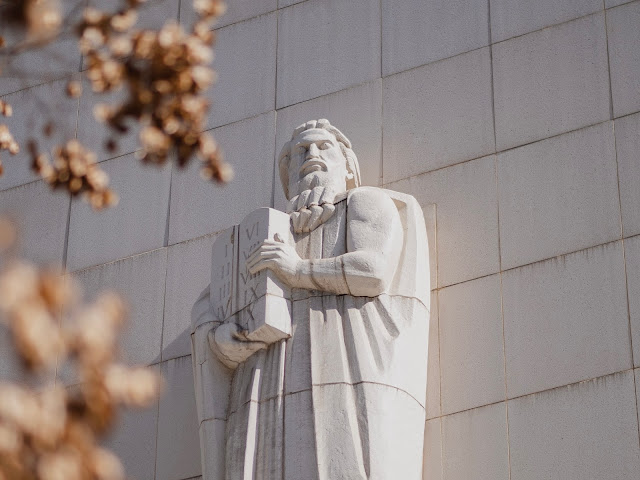
Moses holding the tablets of the ten commandments
Q. 41: Wherein is the moral law summarily comprehended? 
Answer: The moral law is summarily comprehended in the ten commandments.

Q. 42: What is the sum of the ten commandments?
Answer: The sum of the ten commandments is, To love the Lord our God with all our heart, with all our soul, with all our strength, and with all our mind; and our neighbour as ourselves. (WSC

God’s moral law is not random and arbitrary, but is ultimately unified, capable of being summarized in basic principles as well as being applied to particular situations. When Jesus was asked about the great commandment, he did not merely give them the most important commandments. He gave them two commandments which were foundational to the rest of the law and the prophets.
“And he said to him, “You shall love the Lord your God with all your heart and with all your soul and with all your mind. This is the great and first commandment. And a second is like it: You shall love your neighbor as yourself. On these two commandments depend all the Law and the Prophets.” (Matthew 22:37–40)
These two commandments summarize the ten commandments, which in turn summarize the rest of the moral law. The ten commandments command us to love the Lord our God through exclusive religious commitment, pure worship, a reverent use of his name, and the observance of his holy day. The ten commandments command us to love our neighbor by honoring human authorities, by preserving our own and our neighbor’s life, chastity, wealth, and good name, and by a content, just, and charitable frame of mind toward our neighbor and his belongings. These duties ought to be done from love and in love as ways to express this love for God and neighbor. Romans 13:7-10 exemplifies how the ten commandments are summarized in Scripture with the duty to love. 

The moral law is explained and taught throughout Scripture. But it is summarily comprehended in the ten commandments in such a way that further explanation can be seen as drawing out what is implied by the ten commandments themselves.

It is important to note that the same law that condemns us as sinners is the same law that believers are taught to live by (Rom. 7-8:9, 13:7-10). The law which was given to Adam and Eve in the garden is the same law to which we are being conformed as we are being renewed by Christ. It was given to Adam and Eve as a covenant of works, and it was given again at Mount Sinai as part of the covenant of grace, to be observed by his people who were redeemed by grace. The law which is that perfect expression of God’s character is the same law we follow as his people, to show our love, gratitude, loyalty, and likeness to him.

Thursday, December 30, 2021

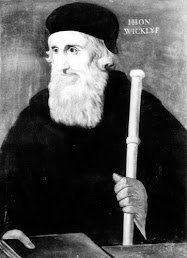
John Wycliffe (c. 1330-1384)

In honor of tomorrow's anniversary of John Wycliffe's death (December 31, 1384), here is a timeline and history of him, his context, and his followers. 

1303 - Pope Boniface VIII issued Unam Sanctam, which asserted his authority over the state and claimed “Now, therefore, we declare, say, determine and pronounce that for every human creature it is necessary for salvation to be subject to the authority of the Roman pontiff.” He was then arrested by French troops and died shortly after.

1305-1376 - “The Babylonian captivity of the papacy,” in which the papacy was moved to France, under the watchful eye of the French king. 

1327 - Edward III begins his fifty-year reign as King of England. 

c. 1330 - John Wycliffe was born. 

1337 - The Hundred Years War between England and France begins (this led to a greater emphasis on English identity and language and increased tension with the pope who was in France).

1344 - Thomas Bradwardine, a chaplain to the king, wrote The Cause of God against the Pelagians, a work teaching God’s sovereignty, predestination, and grace that would influence Wycliff. 

1346-1353 - The black plague struck Europe, killing about 1/3 of the population (about 25 million people).

1372 - John Wycliffe received his doctorate in theology from Oxford University. 

1374-1377 - John Wycliffe began to publish his writings on government and the reform of the church.

1377 - Pope Gregory XI denounced some of Wycliffe’s teachings, but King Edward III died and Wycliffe was protected by supports like John of Gaunt. Pope Gregory XI died the next year. The new English king, Richard II, was only ten years old. Around the same time, William Langland wrote Piers Plowman

1378-1417 - The Western Schism, in which more than one person claimed to be pope.

1380 - John Wycliffe began to teach against the doctrine of transubstantiation, arguing that Christ is present in the Lord’s Supper in a spiritual and sacramental manner. His support among the nobility began to decline. He also increasingly argued for Scripture as the supreme authority over the church and against the legitimacy of the papacy. He began overseeing a translation of the Bible into English and he trained priests to go out and preach to the people.

1381 - The Peasants’ Revolt. Wycliffe denounced the revolt, but some blamed him for it. 

1382 - Anne of Bohemia married Richard II of England, connecting the two countries. Wycliffe’s writings would thus be carried to Bohemia and promoted by Jan Hus a couple decades later. 

1384 - John Wycliffe suffered a stroke while leading worship and died soon after on December 31st.

1387 - Geoffrey Chaucer began writing The Canterbury Tales.

1388 - The translation of the Bible overseen by Wycliffe was revised and released by John Purvey. 

1428 - As he had been declared a heretic in 1415, Wycliffe’s corpse was unburied and burned. 

Those who agreed with Wycliff and carried on his legacy in England were known as Lollards. For a time, despite persecution, Lollards included some men of influence, such as some Oxford scholars and a group of knights during the reign of Richard II (1377-1399). This group of knights submitted “The Twelve Conclusions” (1395) to Parliament, expressing Lollard hopes for reform. In addition, they stressed the importance of preaching and access to Scripture in English. 

In 1401, John Purvey, a priest and Wycliff’s assistant, was forced to recant (although he preached Lollard teachings afterwards and later died in prison) and William Sawtry, a priest, was burned for such “heresies” as denying transubstantiation. In 1414, Sir John Oldcastle, who had been imprisoned for Lollard beliefs and has escaped, led an uprising, which failed. After this, Lollards found less support among higher ranks and survived more among craftsmen, merchants, and other commoners.  

Throughout the 1400s, Lollards continued to operate, occasionally being prosecuted. Books of the Bible and tracts were copied and circulated. Preachers traveled with these ideas. Their ideas circulated among the people. From 1455-1487, the War of the Roses engulfed England. King Richard III owned a Lollard translation of the Bible. Around 1490, the Lollards and their persecution began to grow again. In the 1520s, the Lollards welcomed and helped spread the writings of the Reformers like William Tyndale, merging with the Protestant Reformation.


Wednesday, December 29, 2021

The Moral Law

Q. 40: What did God at first reveal to man for the rule of his obedience?
Answer: The rule which God at first revealed to man for his obedience, was the moral law. (WSC)

When God created the world, he revealed to man the moral law. The “moral” law refers to the unchanging standard of right and wrong based upon the holy character of God and the way he designed the world. The moral law can be called “natural law,” since it is based on the nature of God and creation. This law does not offer forgiveness to sinners, but instead condemns the least violation of its perfect standard.

The moral law is revealed both through natural revelation and special revelation. Originally, Adam and Eve had knowledge of the moral law in their conscience, being created in the perfect image of God. Even among those who are in rebellion against the law, the law continues to work on their hearts through the conscience (Rom. 2:14-15). Man is confronted by the purpose evident in the created order and in his conscience, but he seeks to silence these sources of conviction. Therefore, as we will see in the next catechism question, this same law is revealed, with more power and clarity, in Scripture (Rom. 7:7, Ps. 19:7-11).

The moral law of God is not arbitrary. It is “holy and righteous and good” (Rom. 7:12). As John Murray remarked,
“What is moral law? Law frequently sounds to our uninstructed ears as something very primitive, crude, temporary, arbitrary. Antinomian tendencies inherent in our sinful hearts, and given widespread currency in much of what professes to be evangelical teaching, are responsible for this. It is due, however, to complete misunderstanding, or still worse, perversity. Moral law is in the last analysis but the reflection or expression of the moral nature of God. God is holy, just and good, and the law which is also holy, just and good is simply the correlate of the holiness and justice and goodness of God. Man is created in the image of God and the demand, the inescapable postulate of that relation that man sustains to God as responsible and dependent creature, is that he be conformed in the inmost fibre of his moral being and in all the conditions and activities of his person to the moral perfection of God. ‘Ye shall be holy, for I am holy.’ ‘Ye shall be perfect, even as your Father in heaven is perfect.’… Moral law is the moral perfection of God coming to expression for the regulation of life and conduct.” (“The Sanctity of the Moral Law,” 1935).

Tuesday, December 21, 2021

The Duty of Man

Q. 39: What is the duty which God requireth of man?
Answer: The duty which God requireth of man, is obedience to his revealed will. (WSC)

This catechism question introduces the second half of the catechism. In the first part it explained what we are to believe concerning God: his nature, decrees, and works of creation, providence, and redemption. From this point forward, it will explain the duty that God requires of us.

Fundamentally, the duty God requires of man is obedience to his revealed will. As the confession of faith says, “Good works are only such as God hath commanded in his holy Word, and not such as, without the warrant thereof, are devised by men out of blind zeal, or upon any pretense of good intention.” God has not told us everything there is to know, but he has told us what he requires from us and has not left it to the free imagination of man. God desires obedience. When God made his covenant with Israel, he had told them, “The secret things belong to the LORD our God, but the things that are revealed belong to us and to our children forever, that we may do all the words of this law” (Deut. 29:29).

We find this point made several times in Scripture. Micah 6:6-8 asks this very question, what does the Lord require? Not extravagant offerings devised by the imagination (6:6-7), but rather, “He has told you, O man, what is good; and what does the LORD require of you but to do justice, and to love kindness, and to walk humbly with your God?” (6:8). The epitome of blind zeal would be King Saul. He repeatedly came up with his own ways of serving the Lord while neglecting what God had told him to do. When Saul spared the spoil of the Amalekites to sacrifice to the Lord, when the Lord had told him to destroy it, Samuel says,
“Has the LORD as great delight in burnt offerings and sacrifices,
    as in obeying the voice of the LORD?
Behold, to obey is better than sacrifice,
    and to listen than the fat of rams.
For rebellion is as the sin of divination,
    and presumption is as iniquity and idolatry.”
(1 Samuel 15:22–23)
Reflecting on this passage, William Tyndale remarked,
“Without God’s word do nothing. And to his word add nothing, neither pull anything away therefrom, as Moses everywhere teacheth thee. Serve God in the spirit, and thy neighbour with all outward service. Serve God as he hath appointed thee and not with thy good intent and good zeal. Remember Saul was cast away of God forever for his good intent. God requireth obedience unto his word and abhorreth all good intents and good zeals which are without God’s word. For they are nothing else than plain idolatry and worshipping of false gods.” (The Obedience of the Christian Man, 1528)

Tuesday, December 14, 2021

The Resurrection and the Day of Judgment

Q. 38: What benefits do believers receive from Christ at the resurrection? 
Answer: At the resurrection, believers being raised up in glory, shall be openly acknowledged and acquitted in the day of judgment, and made perfectly blessed in the full enjoying of God to all eternity. (WSC)

The resurrection will occur which Christ returns at the end of the age (1 Cor. 15:23). At that time, “all who are in the tombs will hear his voice and come out, those who have done good to the resurrection of life, and those who have done evil to the resurrection of judgment” (John 5:28–29). All shall be raised and judged by Christ. 

Those who have received him by faith will be openly acknowledged and acquitted by him, while those who have not done so will be condemned by him for their sins (Matt. 10:32-33, 2 Cor. 5:10). The only basis for our acquittal will be the righteousness of Christ imputed to us (Rom. 5:9-11, Phil. 3:8-11). The good works of believers will be praised and rewarded as testimonies to their genuine relation to Christ, while the evil works of unbelievers will be exposed and condemned as just grounds for their punishment (Matt. 7:21-23, 12:36-37, 25:31-46).

Having been acknowledged and acquitted, Jesus shall welcome us into our eternal inheritance. “Come, you who are blessed by my Father, inherit the kingdom prepared for you from the foundation of the world” (Matthew 25:34). We shall fully achieve the end for which we were made, glorifying God and enjoying him forever. As the Larger Catechism says, we shall be 
“filled with inconceivable joys, made perfectly holy and happy both in body and soul, in the company of innumerable saints and holy angels, but especially in the immediate vision and fruition of God the Father, of our Lord Jesus Christ, and of the Holy Spirit, to all eternity.” 
Revelation 21:1-4 describes this final state, where death, mourning, and pain shall have passed away with the former order of things and where God dwells with his perfected and glorified people.

Tuesday, December 7, 2021

The Christian and Death


Q. 37:
What benefits do believers receive from Christ at death?
Answer: The souls of believers are at their death made perfect in holiness, and do immediately pass into glory; and their bodies, being still united to Christ, do rest in their graves till the resurrection. (WSC)

Nothing can separate us from the love of God in Christ Jesus our Lord - not even death (Rom. 8:38-39). Not only do we receive abundant blessings during this life in Christ, but we are also blessed in him at death. At death, an unnatural separation is made between body and soul. Humanity was not designed to suffer such a separation. It is because of sin that this curse was laid upon mankind. Yet for Christians, the sting of death has been taken away. While it remains unnatural and a painful and sorrowful separation (not only of body and soul, but a separation from loved ones), yet for Christians it is not a curse for sin, but an entrance into the next stage of blessings in Christ. As the Heidelberg Catechism puts it, “Our death is not a satisfaction for our sins, but only an abolishing of sin, and a passage into eternal life.” 

The souls of believers are at their death made perfect in holiness (Heb. 12:23). The pass into glory immediately, not through a purgatorial process. Paul makes clear that when we are away from the body, we will be at home with the Lord (2 Cor. 5:6-8). As he said in Philippians, “to die is gain,” for to die is “to depart and be with Christ” (Phil. 1:21, 23). As Revelation 14:13 says, 
“And I heard a voice from heaven saying, ‘Write this: Blessed are the dead who die in the Lord from now on.’ ‘Blessed indeed,’ says the Spirit, ‘that they may rest from their labors, for their deeds follow them!’” 
While the souls of the wicked are cast into torment (Luke 16:23-24), the souls of the righteous enjoy peace, holiness, joy in the immediate presence of Christ, free from sin and pain. “...in your presence there is fullness of joy; at your right hand are pleasures forevermore” (Psalm 16:11).

The bodies of believers are not neglected by God. They are not cast away like useless husks. Christ is united to us, body and soul, so that your bodies are members of Christ (1 Cor. 6:15). Your bodies have been freed by Christ from the mastery of sin and have been made instruments for righteousness (Rom. 6:12-19). Therefore, when you die, your body will still be united to Christ. It will rest in its grave as its bed. While it will see corruption, yet it will be restored, glorified, and reunited with your soul when Christ returns (Rom. 8:11, 23, John 5:28-29, Job 19:26-27). Therefore, as a Christian, you can with hope and confidence commit yourself, body and soul, to the Lord and his keeping.

Wednesday, December 1, 2021

Christian Experience

Q. 36: What are the benefits which in this life do accompany or flow from justification, adoption, and sanctification? 
Answer: The benefits which in this life do accompany or flow from justification, adoption, and sanctification, are, assurance of God's love, peace of conscience, joy in the Holy Ghost, increase of grace, and perseverance therein to the end. (WSC)

As Romans 5:1–5 teaches, “since we have been justified by faith,” we therefore “have peace with God” and “rejoice in hope of the glory of God.” We can rejoice even in suffering, knowing that it shall produce endurance, character, and hope. And our hope can be confident, since “love of God has been poured into our hearts.”

The assurance of God’s love, peace of conscience, and joy in the Holy Spirit all result from a personal knowledge of justification, adoption, and sanctification. When we receive and rest upon God’s grace through Christ, we come to know his love for us and to gain confidence before him (1 John 4:14-18). These blessings grow as we grow in our understanding, appreciation, and experience of this salvation and as we grow in our certainty that we possess it personally.

There are some believers who are saved but are not sure they are saved. True Christians can struggle with doubt and uncertainty concerning their salvation. But the more we are certain that we have been saved, the more we will enjoy the peace and joy of this salvation. The Spirit guides us into an assurance of salvation as we consider the promises of salvation and the sanctifying work of God in our lives (1 John 5:13, Rom. 8:15–16).

Increase of grace and perseverance to the end also come with justification, adoption, and sanctification. As Paul wrote, “I am sure of this, that he who began a good work in you will bring it to completion at the day of Jesus Christ” (Phil. 1:6). Nothing can separate those who have been justified from the love of God in Christ Jesus our Lord (Rom. 8:31-39). The believer is born again of an imperishable seed, the living and abiding word of God (1 Peter 1:23). Increase of grace may not always be steady or perceptible. We do well to bewail before God our lethargy in spiritual growth. Yet, sin shall not have dominion over us (Rom. 6:14). Christ will continue to give life and spiritual growth to his people (Eph. 4:15-16, Col. 2:18-19). So let us pursue this growth with confidence, trusting in our Savior and seeking this growth in the way he has taught us.